For accountants who want a dedicated desk calculator, the Victor 6500 is the best overall pick in this lineup, thanks to its loan-focused tools alongside everyday desktop calculations. The Sharp QS-2130 is a strong fit for a steady stream of office arithmetic, while the Casio DM-1200BM stands out for cost, selling price, and margin work. The key tradeoff is between familiar, fast-entry desktop layouts and specialized financial functions; not every business calculator replaces a true financial calculator. Read on for the full breakdown and help matching a model to your daily accounting tasks.

Get smart everyday buys delivered free with Prime
- Fast, free delivery on millions of items
- Prime Video, Amazon Music and more included
- Member-only deals all year
Key Takeaways
- The Victor 6500 is the most finance-focused desk option in this group because its Loan Wizard gives it a clearer role for loan-related calculations than general business models.
- Dedicated margin keys change the workflow. The Casio DM-1200BM is the clearest fit for cost, selling price, and margin calculations, while standard desk models favor general arithmetic.
- Dual power is a practical office feature, not a substitute for financial functions. Several Sharp and Victor models offer it, but buyers should still check whether the calculator handles the formulas they use.
- The Texas Instruments BA II Plus serves a different purpose from the desktop models. It is better suited to structured financial calculations than to acting as a large-key desk calculator for routine entry.
- Tax and currency tools are task-specific advantages. The Casio MS-80B is the standout when those shortcuts match a regular workflow; otherwise, a more general desktop model may be the more useful choice.
| Victor 12-Digit Dual-Power Desk Calculator, Black |  | Best Overall for Desk-Based Profit Work | Model: 1180-3A | Calculator type: Business/financial calculator | Display: 12-digit LCD with adjustable angle | VIEW LATEST PRICE | See Our Full Breakdown |
| Sharp EL-334WB 12-Digit Dual-Power Business Calculator |  | Best for Repetitive Batch Entry | Model: EL-334WB | Digits: 12 | Display: 4-inch fixed LCD | VIEW LATEST PRICE | See Our Full Breakdown |
| Casio MS-80B Desktop Calculator, Tax & Currency Tools |  | Best for Basic Tax and Currency Checks | Calculator type: Standard, general-purpose calculator | Display: 8-digit LCD | Power: Solar Plus | VIEW LATEST PRICE | See Our Full Breakdown |
| Sharp QS-2130 12-Digit Dual-Power Desktop Calculator |  | Best for a Full-Size Keypad | Model: QS-2130 | Calculator type: Business | Display: 12-digit LCD | VIEW LATEST PRICE | See Our Full Breakdown |
| Texas Instruments BA II Plus Financial Calculator | 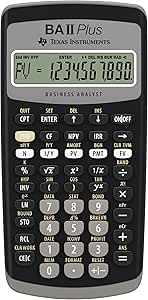 | Best for Financial Analysis | Model: BA II Plus (IIBAPL/TBL/1L1/C) | Functions: NPV, IRR, cash-flow analysis, time-value-of-money calculations, amortization, bond, depreciation, compound-interest worksheets | Statistics: List-based one- and two-variable statistics; linear, logarithmic, exponential, and power regression | VIEW LATEST PRICE | See Our Full Breakdown |
| Casio DM-1200BM Business Desktop Calculator with Cost/Sell/Margin Functions, Silver |  | Best for Cost and Margin Work | Calculator type: Business desktop | Display: 12-digit LCD | Power: Solar with battery backup | VIEW LATEST PRICE | See Our Full Breakdown |
| Victor 6500 12-Digit Desktop Financial Calculator with Loan Wizard | 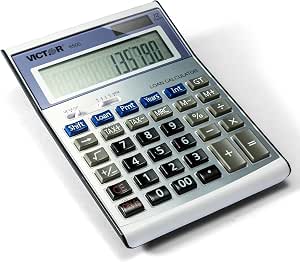 | Best for Loan Calculations | Calculator type: Financial desktop | Display: Angled 12-digit LCD | Digit height: 21 mm | VIEW LATEST PRICE | See Our Full Breakdown |
| Sharp VX-2128V 12-Digit Dual-Power Desktop Calculator |  | Best for Checking Everyday Business Arithmetic | Calculator type: Business desktop | Digits: 12 | Display: Tilt LCD with fold-up kickstand | VIEW LATEST PRICE | See Our Full Breakdown |
| CATIGA CF-300 Professional Financial Calculator |  | Best for Advanced Financial Analysis | Calculator type: Financial | Display: 2-inch LCD | Power: Battery powered | VIEW LATEST PRICE | See Our Full Breakdown |
| desktop financial calculators for accountant | Display | Power | Dimensions | Calculator type |
|---|---|---|---|---|
| Victor 12-Digit Dual-Power Des | 12-digit LCD with adjustable angle | Solar and 1 LR44 battery | 6.5 x 4 inches | Business/financial calculator |
| Sharp EL-334WB 12-Digit Dual-P | 4-inch fixed LCD | Solar with 1 LR44 battery backup, included | 6.6 x 4.4 inches | — |
| Casio MS-80B Desktop Calculato | 8-digit LCD | Solar Plus | 5.79 x 4.06 inches | Standard, general-purpose calculator |
| Sharp QS-2130 12-Digit Dual-Po | 12-digit LCD | Solar and 1 LR44 battery | 6.9 x 7.3 inches | Business |
| Texas Instruments BA II Plus F | — | — | 6.48 x 2.98 x 0.72 inches | — |
| Casio DM-1200BM Business Deskt | 12-digit LCD | Solar with battery backup | 10.32 × 7.87 in | Business desktop |
| Victor 6500 12-Digit Desktop F | Angled 12-digit LCD | Solar and battery | — | Financial desktop |
| Sharp VX-2128V 12-Digit Dual-P | Tilt LCD with fold-up kickstand | Solar and battery | 5.5 × 8.2 in | Business desktop |
| CATIGA CF-300 Professional Fin | 2-inch LCD | Battery powered | 6.46 × 3.15 in | Financial |
More Details on Our Top Picks
Victor 12-Digit Dual-Power Desk Calculator, Black
I’d put the Victor 1180-3A first for accountants who regularly check costs, selling prices, and margins at a desk. Its 12-digit adjustable-angle display pairs with dedicated cost, sell, and margin keys, giving it a more direct workflow for profit checks than the Casio MS-80B, which has tax and currency tools but only eight digits. Independent memory and a backspace key also help when figures need to be stored or an entry corrected mid-calculation.
The tradeoff is a plastic enclosure and a required LR44 battery, even though solar power is available. The Sharp EL-334WB adds a grand total key and double-zero key, which may suit repetitive batch entry better; the Victor’s adjustable screen and rounding controls make it the more flexible everyday desk choice. Its recycled-plastic content is a useful material detail, not a substitute for a sturdier build.
Pros:- Dedicated cost, sell, and margin keys support quick profit calculations.
- Adjustable 12-digit display can be angled to suit a desk setup.
- Solar and LR44 battery power provide two operating power sources.
- Backspace, rounding and decimal switches, and independent memory support routine calculation work.
Cons:- Requires an LR44 battery for battery backup.
- Plastic enclosure is less substantial than a metal-bodied design.
- Lacks the dedicated grand total and double-zero keys found on the Sharp EL-334WB.
Best for: Accountants who want a desk calculator for frequent cost, selling-price, and margin checks, along with a full 12-digit readout.
Not ideal for: Accountants who need amortization, cash-flow analysis, or other time-value-of-money worksheets; the Texas Instruments BA II Plus is better suited to those tasks.
- Model:1180-3A
- Calculator type:Business/financial calculator
- Display:12-digit LCD with adjustable angle
- Power:Solar and 1 LR44 battery
- Functions:Cost, sell, margin, decimal and rounding switches, backspace, percent, square root, change sign, 3-key independent memory
- Dimensions:6.5 x 4 inches
- Weight:4.64 ounces
- Enclosure:Plastic, made with 40% recycled plastic
Our verdict“Choose the Victor 1180-3A for a flexible 12-digit desk calculator centered on cost, selling-price, and margin work.”
Sharp EL-334WB 12-Digit Dual-Power Business Calculator
The Sharp EL-334WB makes the most sense for accountants who enter repeated figures and want quick corrections without leaving the keypad workflow. Its double-zero key speeds entry of amounts with trailing zeros, while grand total and backspace keys help manage accumulated figures and fix typos. Like the Victor 1180-3A, it includes cost-sell-margin functions and a 12-digit display; unlike the Victor, its screen is fixed, so it gives up viewing-angle flexibility for a straightforward layout.
Solar operation with an included LR44 backup battery helps keep it ready for desk use, but the plastic body is a modest build and the calculator is not a substitute for advanced financial worksheets. The Sharp QS-2130 offers a roomier, full-size 10-key layout, while this model is smaller and lighter. I’d favor the EL-334WB for routine business arithmetic, not for loan, bond, or cash-flow analysis.
Pros:- Double-zero key helps speed entry of amounts with repeated trailing zeros.
- Grand total key supports accumulating figures across a series of calculations.
- Backspace key lets users correct an entry without restarting the calculation.
- Solar power with an included LR44 battery backup supports desk use.
Cons:- Fixed display cannot be angled toward the user like the Victor 1180-3A.
- Plastic enclosure offers no upgrade in build material over other desk options.
- Does not provide the financial worksheets available on the Texas Instruments BA II Plus.
Best for: Accountants processing batches of invoices or totals who value a double-zero key, grand total function, and quick entry correction.
Not ideal for: Users who need an adjustable display, a full-size 10-key layout, or time-value-of-money and cash-flow worksheets.
- Model:EL-334WB
- Digits:12
- Display:4-inch fixed LCD
- Power:Solar with 1 LR44 battery backup, included
- Functions:Cost-sell-margin, grand total, double-zero, backspace
- Dimensions:6.6 x 4.4 inches
- Weight:4.96 ounces
- Warranty:1 year
Our verdict“Pick the Sharp EL-334WB if your daily desk work centers on repeated number entry and running totals rather than advanced financial analysis.”
Casio MS-80B Desktop Calculator, Tax & Currency Tools
The Casio MS-80B is the simplest fit here for accountants who need occasional tax or currency calculations alongside everyday arithmetic. Its tax and currency functions address quick percentage and conversion tasks that the Sharp QS-2130’s listed markup and memory functions do not specifically cover. Solar Plus power is described as working in dim light, and the compact body is easier to carry between a desk and a briefcase than the larger Sharp QS-2130.
Its main limitation for accounting work is the eight-digit display: both the Victor 1180-3A and Sharp EL-334WB show 12 digits, making them more suitable for longer figures. The available product data also does not list a cost-sell-margin function, so I would not choose it as a primary profit-analysis desk calculator. This Casio is a general-purpose companion, not a replacement for the BA II Plus when amortization or cash-flow worksheets are needed.
Pros:- Tax and currency exchange functions support quick routine financial checks.
- Solar Plus power is specified to work in dim light.
- Compact dimensions suit a crowded desk or briefcase.
- Memory keys, percent, and square root cover common general-purpose calculations.
Cons:- Eight-digit display shows fewer digits than the 12-digit Victor and Sharp business models.
- No cost-sell-margin function is listed for dedicated profit calculations.
- Does not offer the specialized financial worksheets of the Texas Instruments BA II Plus.
Best for: Accountants who mainly handle everyday arithmetic and occasional tax or currency calculations, and want a compact calculator for desk or bag use.
Not ideal for: Users who regularly work with long figures, need cost-sell-margin keys, or rely on financial worksheets; the 8-digit display and general-purpose feature set are limiting.
- Calculator type:Standard, general-purpose calculator
- Display:8-digit LCD
- Power:Solar Plus
- Functions:Tax, currency exchange, memory, square root, percent
- Screen size:3.25 inches
- Dimensions:5.79 x 4.06 inches
- Color:Brush nickel
- Enclosure:Plastic
Our verdict“Choose the Casio MS-80B as a compact general-purpose companion for tax and currency checks, not as your main calculator for longer accounting figures.”
Sharp QS-2130 12-Digit Dual-Power Desktop Calculator
For accountants who prefer a broad, well-spaced keypad, the Sharp QS-2130 has the clearest advantage in this group: its full-size 10-key layout gives fingers more room during sustained desk entry. It also supplies a 12-digit display, memory and markup keys, and solar-plus-battery power. Compared with the smaller Sharp EL-334WB, this is the more substantial desktop layout, though it does not list that model’s grand total, double-zero, or backspace keys.
The printer-free slim design avoids the bulk and paper handling of a printing calculator, but the 9.12-ounce weight and 6.9 x 7.3-inch footprint make it less portable than the Victor 1180-3A. It is still a basic business calculator, not a financial worksheet machine: the BA II Plus is the better match for amortization, bonds, or cash-flow analysis. The plastic enclosure and separately required LR44 battery are further tradeoffs.
Pros:- Full-size, well-spaced 10-key layout accommodates frequent number entry.
- 12-digit LCD supports longer figures than the Casio MS-80B.
- Memory and markup keys add utility for routine business calculations.
- Solar and battery power provide two power sources without a printer or paper roll.
Cons:- Larger and heavier than the Victor 1180-3A, making it less convenient to carry.
- Requires a separate LR44 battery.
- Listed functions are more limited than the BA II Plus for financial analysis.
Best for: Accountants who work primarily at one desk and want a roomy 10-key layout for sustained numerical entry.
Not ideal for: People who need a compact travel calculator, dedicated cost-sell-margin or grand-total keys, or financial worksheets for loans and cash flows.
- Model:QS-2130
- Calculator type:Business
- Display:12-digit LCD
- Power:Solar and 1 LR44 battery
- Features:Memory and markup keys
- Dimensions:6.9 x 7.3 inches
- Weight:9.12 ounces
- Enclosure:Plastic
Our verdict“Choose the Sharp QS-2130 if keypad spacing matters more to your desk workflow than portability or specialized financial functions.”
Texas Instruments BA II Plus Financial Calculator
The Texas Instruments BA II Plus is the clear choice in this set for accountants whose calculations go beyond desk arithmetic. Its time-value-of-money, NPV, IRR, and cash-flow tools address work the Victor 1180-3A and Sharp EL-334WB are not described as handling. Worksheets for amortization, bonds, depreciation, and compound interest let users keep related financial calculations organized, while stored worksheet values can reduce repeated setup.
That capability comes with a learning curve: the worksheet-based interface takes more practice than the direct cost-sell-margin keys on the Victor or the simple entry workflow of the Sharp QS-2130. It is also a handheld model rather than a broad desktop keypad, so it may feel less comfortable for high-volume basic entry. I’d choose it for analysis and coursework, but skip it if the job is mostly routine totals and margin checks. The included slide case protects the screen; the listed CR123A battery is a less familiar requirement than the LR44 cells used by several desk models.
Pros:- Handles NPV, IRR, uneven cash flows, and time-value-of-money calculations.
- Includes worksheets for amortization, bonds, depreciation, and compound interest.
- Stores previous worksheet values for repeated financial calculations.
- Supports one- and two-variable statistics with four regression options and includes a slide case.
Cons:- Worksheet functions can take time to learn.
- Handheld form is less suited to high-volume desk entry than the Sharp QS-2130.
- Uses a CR123A battery rather than the LR44 type used by several other models here.
Best for: Accountants, finance professionals, and students who calculate loan payments, bond values, depreciation, NPV, IRR, or uneven cash flows.
Not ideal for: Users who mainly need a large desktop keypad for rapid basic arithmetic, percentage checks, or cost-sell-margin calculations.
- Model:BA II Plus (IIBAPL/TBL/1L1/C)
- Functions:NPV, IRR, cash-flow analysis, time-value-of-money calculations, amortization, bond, depreciation, compound-interest worksheets
- Statistics:List-based one- and two-variable statistics; linear, logarithmic, exponential, and power regression
- Battery:1 CR123A battery, included
- Dimensions:6.48 x 2.98 x 0.72 inches
- Weight:3.68 ounces
- Material:ABS plastic
- Included accessory:Slide case
Our verdict“Choose the BA II Plus when your accounting work requires financial analysis tools rather than the larger, simpler keypad of a desktop business calculator.”
Casio DM-1200BM Business Desktop Calculator with Cost/Sell/Margin Functions, Silver
The Casio DM-1200BM is the most direct fit here for accountants who regularly calculate selling prices and margins: dedicated cost, sell, and margin keys reduce the need to work through those figures manually. Its 12-digit display and angled kickstand suit a fixed desk setup, while solar power with battery backup supports use when lighting changes. Compared with the Victor 6500, it puts pricing workflows ahead of loan-variable calculations; the Victor is the stronger match when loan inputs are routine. The Casio also includes tax keys, but it lacks the listed loan and statistical tools found on more specialized financial models. Its plastic enclosure is less substantial than the Victor’s metal enclosure, and backup operation depends on an LR44 battery. Choose it for frequent margin and tax arithmetic, not advanced financial analysis.
Pros:- Dedicated cost, sell, and margin keys support common pricing calculations.
- 12-digit LCD provides room for longer business figures.
- Angled kickstand improves visibility on a desk.
- Solar power with battery backup supports operation across changing light conditions.
Cons:- Plastic enclosure feels less substantial than the metal-bodied Victor 6500.
- Battery backup requires an LR44 cell.
- Does not list specialized functions such as TVM, IRR, or NPV.
Best for: Accountants and bookkeepers who frequently work out costs, selling prices, margins, and tax figures at a fixed desk.
Not ideal for: Accountants who need loan-variable, TVM, IRR, or NPV calculations, or buyers who prefer a metal-bodied desktop calculator.
- Calculator type:Business desktop
- Display:12-digit LCD
- Power:Solar with battery backup
- Battery:1 LR44 included
- Functions:Cost, sell, margin, and tax calculations
- Dimensions:10.32 × 7.87 in
- Weight:12 oz
- Enclosure:Plastic; silver
- Warranty:1 year
Our verdict“Choose the DM-1200BM for desk-based cost, margin, and tax work, but pick a specialized financial model for loan or investment analysis.”
Victor 6500 12-Digit Desktop Financial Calculator with Loan Wizard
For accountants handling loan figures alongside everyday business arithmetic, the Victor 6500 earns its place with a Loan Wizard that solves a missing variable from three known inputs. That can make payment, rate, or term scenarios less laborious than using a general desktop model such as the Sharp VX-2128V, whose listed strengths focus on tax, markup, and checking calculations. The Victor’s angled 12-digit display uses 21 mm digits, which helps keep figures legible during desk work, and its metal enclosure gives it a sturdier profile than the plastic Casio DM-1200BM. It also includes tax keys, grand total, delta percent, and independent memory. The tradeoff is specialization: it is a desktop unit, not a portable handheld, and its two-AA battery requirement adds another power component despite hybrid solar operation.
Pros:- Loan Wizard calculates a missing loan variable from three known inputs.
- Angled 12-digit display has 21 mm digits for clear desk viewing.
- Metal enclosure offers a sturdier construction than the plastic Casio DM-1200BM.
- Tax keys, grand total, delta percent, and independent memory cover routine business calculations.
Cons:- Requires two AA batteries in addition to solar power.
- Desktop format is less suitable for portable use.
- Does not list the TVM, IRR, and NPV functions offered by the CATIGA CF-300.
Best for: Accountants and loan officers who regularly solve for an unknown loan input and want large digits for desk-based work.
Not ideal for: People who need a compact carry-around calculator or whose financial work centers on TVM, IRR, and NPV functions.
- Calculator type:Financial desktop
- Display:Angled 12-digit LCD
- Digit height:21 mm
- Power:Solar and battery
- Batteries:2 AA required
- Key functions:Loan Wizard, tax, grand total, delta percent, independent memory
- Weight:9.6 oz
- Enclosure:Metal; silver
Our verdict“Pick the Victor 6500 when loan-variable calculations and a large, sturdy desktop display matter more than portability or investment-analysis functions.”
Sharp VX-2128V 12-Digit Dual-Power Desktop Calculator
The Sharp VX-2128V is the practical general-purpose choice for accountants who want more than basic addition without moving to a dedicated financial calculator. Its answer-check and backspace functions help catch or correct input mistakes, while tax, markup, item count, and four-key independent memory support common desk workflows. The tilt LCD and fold-up kickstand make the display easier to read from a seated position. Compared with the Casio DM-1200BM, Sharp offers a broader set of checking and memory tools, while Casio is more focused on dedicated cost/sell/margin work. Neither replaces a model such as the CATIGA CF-300 for TVM, IRR, or NPV analysis. The VX-2128V runs on solar with LR44 backup, but its 8.2-inch-long desktop footprint is not a pocket-friendly format.
Pros:- Answer check and single-digit backspace help verify and correct entries.
- Tax, markup, item count, and four-key independent memory support everyday office calculations.
- Tilt LCD with fold-up kickstand suits desk viewing.
- Solar power with LR44 backup and automatic power-down supports regular office use.
Cons:- Desktop dimensions make it less convenient for portable use.
- Battery backup requires an LR44 cell.
- Does not list the advanced financial functions available on the CATIGA CF-300.
Best for: Bookkeepers and accounting staff who need tax, markup, memory, and error-correction tools for routine desktop calculations.
Not ideal for: Accountants who need TVM, IRR, NPV, or loan-wizard functions, or anyone seeking a calculator for pocket carry.
- Calculator type:Business desktop
- Digits:12
- Display:Tilt LCD with fold-up kickstand
- Power:Solar and battery
- Battery:1 LR44 included
- Functions:Tax, markup, memory, answer check, backspace, item count, day/date calculations
- Controls:Selectable decimal and rounding switches
- Dimensions:5.5 × 8.2 in
- Weight:9.6 oz
Our verdict“Choose the VX-2128V for error-checking and routine business arithmetic at a desk, not for specialized loan or investment calculations.”
CATIGA CF-300 Professional Financial Calculator
The CATIGA CF-300 serves a different job from the desk-oriented business models in this group: it brings TVM, IRR, and NPV together with amortization, depreciation, bond pricing, and cash-flow analysis. For accounting work that involves investment evaluation or financing schedules, that range is more relevant than the tax and markup focus of the Sharp VX-2128V or Casio DM-1200BM. It also adds probability and linear regression tools, and its compact dimensions with a flip-open hard case make it easier to carry between workspaces than the desktop Victor 6500. That portability comes with a smaller 2-inch LCD, which can limit the visible information compared with the larger desktop displays. It is battery powered rather than solar-assisted, so it is a specialist portable financial tool, not the simplest shared office calculator.
Pros:- TVM, IRR, and NPV functions support financial and cash-flow analysis.
- Includes amortization, depreciation, bond pricing, break-even, and statistical calculations.
- Compact body and flip-open hard case suit carrying between workspaces.
- Two-year warranty is longer than the one-year warranty listed for the Casio DM-1200BM.
Cons:- The 2-inch LCD shows less information at once than the larger desktop displays.
- Battery-powered operation lacks the solar assistance found on the Victor 6500 and Sharp VX-2128V.
- Compact handheld format is less suited to shared desk use than a full-size desktop calculator.
Best for: Accountants, finance students, and analysts who need portable TVM, IRR, NPV, amortization, or bond calculations.
Not ideal for: Office teams seeking a large, angled desktop display for shared tax and markup calculations, or buyers who prefer solar-assisted power.
- Calculator type:Financial
- Display:2-inch LCD
- Power:Battery powered
- Functions:TVM, IRR, NPV, break-even, depreciation, bond pricing, amortization, probability, linear regression
- Dimensions:6.46 × 3.15 in
- Color:Black
- Case:Flip-open hard case with snap-close design
- Warranty:2 years
Our verdict“Choose the CF-300 for portable financial analysis with TVM, IRR, and NPV, but select a desktop model for larger-screen routine office arithmetic.”

How We Picked
I ranked these calculators around the work an accountant is likely to do at a desk: repeated numerical entry, business calculations, and, where offered, loan, tax, currency, or margin tasks. I also weighed usability cues such as digit capacity, desktop-oriented design, and power options, since a feature matters only if it fits the user’s daily workflow. I did not treat a long feature list as an automatic advantage; specialized keys earned weight when they addressed a clear accounting task.
The ordering reflects role and fit rather than a claim that one model suits every practice. The Victor 6500 leads for its combination of desk use and loan tools, while the Sharp QS-2130 and Casio DM-1200BM serve different everyday needs. The BA II Plus ranks as a specialist financial tool rather than a direct replacement for a desktop calculator. Models with narrower tax, currency, or general arithmetic roles rank lower for accountants who need a broader mix of functions.
| desktop financial calculators for accountant | Calculator type | Power | Enclosure |
|---|---|---|---|
| Victor 12-Digit Dual-Power Des | Business/financial calculator | Solar and 1 LR44 battery | Plastic, made with 40% recycled plastic |
| Sharp EL-334WB 12-Digit Dual-P | — | Solar with 1 LR44 battery backup, included | — |
| Casio MS-80B Desktop Calculato | Standard, general-purpose calculator | Solar Plus | Plastic |
| Sharp QS-2130 12-Digit Dual-Po | Business | Solar and 1 LR44 battery | Plastic |
| Texas Instruments BA II Plus F | — | — | — |
| Casio DM-1200BM Business Deskt | Business desktop | Solar with battery backup | Plastic; silver |
| Victor 6500 12-Digit Desktop F | Financial desktop | Solar and battery | Metal; silver |
| Sharp VX-2128V 12-Digit Dual-P | Business desktop | Solar and battery | — |
| CATIGA CF-300 Professional Fin | Financial | Battery powered | — |
Factors to Consider When Choosing Desktop Financial Calculators For Accountants
Before choosing a model, map your routine tasks to the calculator’s actual keys and workflow. The right desk calculator may speed up recurring arithmetic, but it will not automatically replace spreadsheet checks, accounting software, or a dedicated financial calculator.
Match financial functions to your recurring work
Start by listing the calculations you repeat, such as loan payments, tax additions, currency conversions, or margin checks. A dedicated key can reduce repeated setup, but only when its function matches your method and the figures you need to enter. Do not infer that a model is suited to every financial calculation from the word “financial” in its name. A business calculator with a margin key and a specialist financial calculator solve different problems. If your work centers on amortization or time-value-of-money questions, confirm the specific functions and input conventions before buying. For occasional complex cases, a spreadsheet or approved software workflow may remain the better tool.
Choose a layout for your actual desk workflow
Accountants often enter long strings of figures, so the physical layout can affect speed and error rates more than a seldom-used feature. Think about where the calculator will sit, whether you use it alongside a keyboard, and whether its display is easy to read from your normal position. A desktop model generally favors stable placement and routine entry, while a handheld financial calculator may be easier to carry between desks or meetings. Check key spacing and the placement of common operations if you rely on muscle memory. A compact footprint can free desk space, but cramped keys may be a poor trade for frequent use. Match the form factor to the volume and setting of your calculations.
Treat power options as a continuity choice
Dual-power designs can keep a calculator useful across different lighting and office conditions, but power type alone does not tell you how long it will run or how easy it is to maintain. Check the product details for the supported power source and any battery requirements before purchase. If several people share a desk calculator, simple power arrangements can reduce interruptions when the device is moved or stored. Do not pay extra for a power feature if the calculator otherwise lacks functions your team needs. Also consider whether your office has a policy for replacing small batteries or managing shared equipment. Reliable access matters more than a particular power label.
Separate display capacity from calculation capability
A 12-digit display is useful for entering larger values without splitting them, but it does not make a calculator a financial-function specialist. Match the displayed capacity to the figures your accounting work regularly handles, including the number of digits needed before and after the decimal point. Check how the model presents rounding and whether its operating sequence suits the calculations you perform. When figures feed reports or client records, follow your organization’s rounding rules rather than relying on a calculator’s default behavior. A larger display can help with entry, yet clear verification steps still matter. Prioritize both readable results and a dependable checking process.
Decide whether a desk calculator or a financial calculator belongs in the workflow
These categories overlap, but they are not interchangeable. A desktop business calculator is usually a better fit for rapid arithmetic at a fixed workstation, while a dedicated financial model may offer more targeted calculation modes in a smaller format. Some accountants may benefit from keeping both: one for everyday entry and another for finance-specific problems. Before buying two devices, identify whether the specialized calculator’s functions are used often enough to justify a separate workflow. If a team shares calculations, consistent models and documented procedures can matter more than having the longest feature list. Choose based on the tasks, not the category label alone.
Frequently Asked Questions
Can a desktop business calculator replace a financial calculator for loan work?
Not automatically. A desk model may offer ordinary arithmetic or a loan-focused feature, but that does not mean it includes every time-value-of-money function or follows the input sequence your work requires. Check for the exact calculations you perform, such as payment, term, interest, or amortization tasks. The Victor 6500 is the most directly loan-oriented desktop choice in this lineup, while the BA II Plus is designed for more specialized financial calculations. If loan work is frequent or must follow a prescribed method, verify the model’s documentation before relying on it.
Is a 12-digit display enough for accounting work?
For many routine calculations, 12 digits can accommodate substantial figures, but digit count alone does not settle whether a calculator fits your work. Consider the size of your inputs, the decimal precision you need, and how results are rounded or displayed. A calculator’s key functions and operating logic may matter more when you handle recurring finance tasks. If you often work with large figures or strict precision requirements, compare the display behavior with your organization’s checking procedures. Treat the digit count as one selection factor, not a guarantee of suitability.
Should I choose tax and currency keys if I already use accounting software?
Choose them only if they shorten a recurring task that you still perform at the calculator. The Casio MS-80B is the lineup’s tax- and currency-oriented option, but those shortcuts may add little if all such work happens in software. A dedicated key can help with quick checks or simple calculations away from a computer, yet it does not replace software records or your firm’s approved rates and tax rules. Confirm how the feature is set and whether it matches your procedures. If those tasks are rare, a more general calculator may serve the desk better.
Is a handheld financial calculator practical as the only calculator at an accounting desk?
It can be, if your work depends more on specialized financial functions than on fast, repeated desktop entry. The BA II Plus fills that specialist role in this roundup, but its handheld format differs from the larger desk-oriented models. Think about how often you enter long number sequences and whether the key layout suits your routine. Some users may prefer a dedicated desk calculator for everyday arithmetic and keep a financial model for occasional specialized work. The best single-device choice depends on which task takes up more of your day.
What should a small accounting team prioritize when buying shared calculators?
Prioritize a clear, repeatable workflow over a feature set that only one person understands. A shared calculator should have a layout that staff can use consistently, functions that match the team’s common tasks, and power arrangements that are easy to maintain. If the team regularly checks margins, the DM-1200BM’s cost, selling price, and margin functions may be more useful than tax or currency shortcuts. For loan calculations, the Victor 6500 is a more relevant desktop candidate. Set a shared procedure for rounding and verification, since a calculator cannot standardize those choices by itself.
Conclusion
My best overall choice is the Victor 6500 for accountants who want a desktop format with loan-oriented tools. For best value in everyday business work, the Sharp QS-2130 is a straightforward option to weigh against more specialized models; the Casio DM-1200BM is the better fit when margin calculations are routine. I would point beginners toward a familiar desktop layout such as the Sharp EL-334WB or Victor 12-Digit, then choose between them based on the preferred workflow and power setup. For premium financial specialization, the Texas Instruments BA II Plus is the distinct pick, though it is handheld rather than a conventional desk calculator. Choose the Casio MS-80B for recurring tax and currency shortcuts, and favor the Victor 6500 when loan tasks are the specific need.