
To calculate the cost of equity, you can use several methods. The Capital Asset Pricing Model (CAPM) is popular: it combines the risk-free rate, beta, and market return. For dividend-paying companies, the Dividend Discount Model (DDM) is effective, using dividends and growth rates. Alternatively, the Bond Yield Plus Risk Premium method adds a risk premium to the bond yield. These formulas reflect the return equity investors expect, factoring in the risks they face. Knowing how to calculate this can enhance your investment strategy, and there's more to explore about each method's nuances.

Get smart everyday buys delivered free — and shop member deals
- Fast, free delivery on millions of items
- Access to Prime Big Deal Days deals on October 6–7
- Prime Video, Amazon Music and more included
Key Takeaways
- The Cost of Equity measures the return required by equity investors, reflecting the risk of equity financing compared to debt.
- Common calculation methods include CAPM, DDM, and Bond Yield Plus Risk Premium, each suited for different investment types.
- CAPM calculates Cost of Equity as Risk-Free Rate + Beta × (Market Return – Risk-Free Rate), ideal for volatile stocks.
- DDM uses the formula (Dividends per Share / Current Market Price) + Growth Rate, making it suitable for dividend-paying companies.
- Understanding and applying the correct formula is crucial for accurate capital cost assessments and informed financial decisions.
What Is Cost of Equity?

When you're considering an investment in a company, understanding the cost of equity is crucial. Fundamentally, the cost of equity represents the return required by equity investors for their investment, accounting for the higher risk associated with equity financing compared to debt. This required rate of return influences both your expectations as an investor and the company's financing decisions.
You can calculate the cost of equity using methods like the Capital Asset Pricing Model (CAPM) or the Dividend Discount Model (DDM). CAPM incorporates the market rate of return and the specific risk of the investment, while DDM focuses on expected dividends and their growth. Both approaches have their unique assumptions and applicability, so choosing the right method is key.
Typically, the cost of equity is higher than the cost of debt due to the risks equity investors face. Understanding this metric allows you to gauge whether an investment aligns with your expected return and helps companies make informed decisions regarding their capital structure and project evaluation.
Ultimately, grasping the cost of equity is crucial for evaluating investment opportunities effectively.
Importance of Cost of Equity

Understanding the importance of cost of equity is fundamental for both investors and companies alike. This metric acts as a benchmark, guiding firms to select projects that promise an expected return exceeding their cost of capital. A higher cost of equity often indicates increased market risk and systematic risk, making it more challenging for businesses to attract investment and impacting stock pricing.
As you navigate the financial landscape, consider these key points about cost of equity:
- It influences investment attractiveness, helping investors assess whether a company is worth the risk.
- Accurate calculations are essential for effective capital budgeting and strategic financial planning.
- Understanding your capital structure, including the mix of debt financing and equity, is key for optimizing funding decisions.
Calculation Methods

Calculating the cost of equity is vital for making informed investment and funding decisions. To do this, you can choose from various calculation methods, each suited for different scenarios.
| Method | Formula | Best For |
|---|---|---|
| Capital Asset Pricing Model (CAPM) | Cost of Equity = Risk-Free Rate + Beta × (Market Return – Risk-Free Rate) | Volatile stocks |
| Dividend Discount Model (DDM) | Cost of Equity = (Dividends per Share / Current Market Price) + Growth Rate | Companies that pay dividends |
| Bond Yield Plus Risk Premium | Cost of Equity = Bond Yield + Risk Premium | Risk-sensitive investors |
The CAPM uses Beta to gauge a stock's volatility compared to the market, while the DDM is perfect for companies that consistently pay dividends. If you're considering a more nuanced approach, the Fama-French Model expands on CAPM, factoring in size and value. Finally, the Bond Yield Plus Risk Premium method reflects the extra risk associated with equity over debt. Choosing the right calculation method is essential for accurately determining your expected rate of return and overall cost of capital.
Cost of Equity Examples

How can you effectively illustrate the concept of cost of equity? Let's look at some practical examples to make it clearer.
- Using the Capital Asset Pricing Model (CAPM), if a company has a risk-free rate of 2%, a beta of 1.5, and an expected market return of 8%, the Cost of Equity would be calculated as follows: 2% + 1.5 × (8% – 2%) = 8%.
- With the Dividend Discount Model (DDM), imagine a company paying annual dividends of $3 per share, a market price of $50, and an expected growth rate of 5%. The Cost of Equity calculation would be (3 / 50) + 0.05 = 11%.
- If you apply the Bond Yield Plus Risk Premium approach with a bond yield of 4% and a risk premium of 3%, the Cost of Equity would be 4% + 3% = 7%.
These examples highlight how you can use different methods to determine the Cost of Equity, helping you assess equity capital's cost effectively.
Cost of Equity vs. Cost of Capital
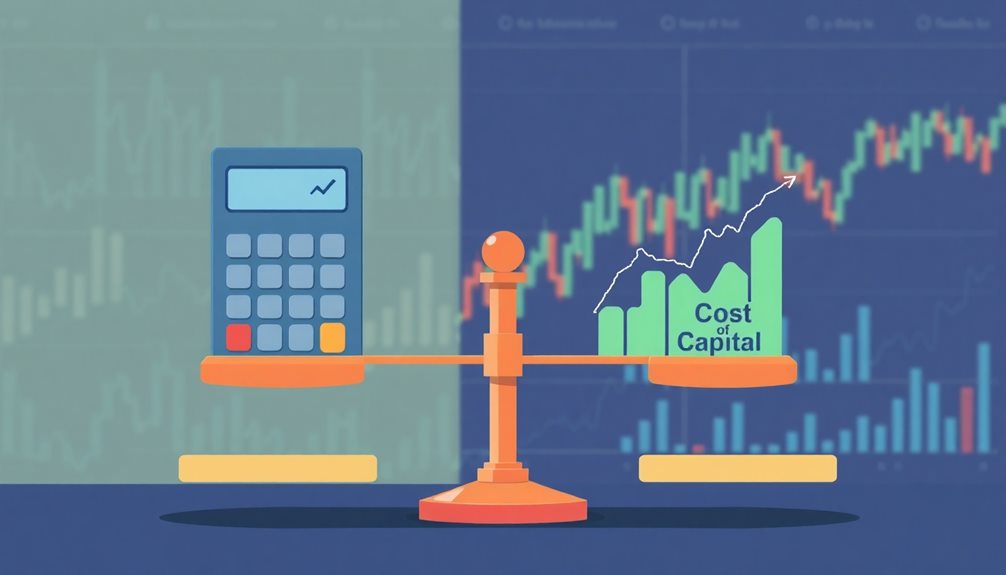
When considering a company's financial strategies, it is essential to distinguish between the cost of equity and the cost of capital. The cost of equity specifically refers to the return required by equity investors, while the cost of capital includes both equity and debt costs, representing the overall financing expense for a company.
| Aspect | Cost of Equity |
|---|---|
| Definition | Return required by equity investors |
| Risk Level | Higher, due to lower liquidation priority |
| Cost Type | Generally higher than cost of debt |
| Calculation Method | Often uses CAPM or DCF methods |
| Impact on WACC | Contributes to the weighted average cost of capital |
Understanding these differences is key to making informed investment decisions. Companies often seek a lower cost of capital by balancing debt and equity in their capital structure. This strategy minimizes financing costs while maintaining financial flexibility. The weighted average cost (WACC) combines both costs, impacting corporate finance decisions and the risk-return trade-off for investors. By knowing how to calculate the cost of equity and capital, you can better evaluate a company's financial health and strategic direction.
Frequently Asked Questions
How Do You Calculate the Cost of Equity?
To calculate the cost of equity, you can use methods like the Capital Asset Pricing Model or the Dividend Discount Model. Both provide insights into expected returns based on risk and dividend growth.
How Do You Calculate Equity Formula?
To calculate equity, you'll need to determine the total assets minus total liabilities. This gives you the net worth of a company. Then, divide that by the number of outstanding shares to find the equity per share.
What Is the Formula for the Cost of Equity Charge?
If you're evaluating a tech startup, the cost of equity charge can be calculated using CAPM: it's the risk-free rate plus beta times the equity risk premium. This helps determine potential returns on your investment.
What Is the Difference Between Cost of Equity and WACC?
The cost of equity reflects the return equity investors expect, while WACC combines that with the cost of debt to show a company's overall financing cost. You'll find WACC generally lower due to debt's lower risk.
Conclusion
In understanding the cost of equity, you're not just grasping a number; you're revealing investment potential, guiding financial decisions, and enhancing your strategic approach. By mastering calculation methods and recognizing its importance, you empower yourself to make informed choices that can lead to better returns. So, whether you're evaluating a new project or appraising your company's performance, knowing how to calculate and interpret the cost of equity will always serve you well.
Evergreen bestsellers Picks
bestsellers
As an affiliate, we earn on qualifying purchases.