

To calculate the Market Value of Equity (MVE), you multiply the current stock price by the total outstanding shares. Make sure to exclude treasury shares for accuracy and consider all issued shares, stock options, and convertible securities. The current stock price fluctuates based on market transactions, so it's important to stay updated as MVE reflects investor sentiment. Understanding this calculation helps you compare companies within the same industry. By grasping how MVE works, you'll reveal deeper insights into a company's valuation and its market dynamics.

Get smart everyday buys delivered free with Prime
- Fast, free delivery on millions of items
- Prime Video, Amazon Music and more included
- Member-only deals all year
Key Takeaways
- Market Value of Equity (MVE) is calculated using the formula: MVE = Current Stock Price × Total Outstanding Shares.
- Total outstanding shares must exclude treasury shares and include all issued shares, options, and convertible securities.
- The current stock price reflects the latest market transactions and is updated regularly for accuracy.
- MVE fluctuates based on company performance, economic conditions, and investor behavior, influencing market sentiment.
- MVE can be expressed on a per-share basis for comparative analysis of companies within the same industry.
financial calculator for stock valuation
As an affiliate, we earn on qualifying purchases.
As an affiliate, we earn on qualifying purchases.
Definition of Market Value of Equity

Understanding the Market Value of Equity (MVE) is crucial for anyone looking to evaluate a company's worth in the stock market. MVE, often referred to as market capitalization, represents the total equity value of a company and is calculated by multiplying the current stock price by the total outstanding shares. This straightforward formula provides a clear snapshot of how much a company's equity is valued in the marketplace.
MVE isn't just a number; it reflects investor sentiment and market conditions, showcasing how much investors are willing to pay for a company's equity based on its perceived growth potential. This metric becomes particularly useful when comparing companies within the same industry, as it helps you assess their relative sizes and financial health.
Keep in mind that MVE can fluctuate considerably due to various factors, including company performance, economic conditions, and investor behavior. This dynamism makes it a crucial measure of a company's worth, allowing you to stay informed about changes in the market and the overall valuation of your investments.
Understanding MVE equips you with the knowledge to make better investment decisions.
As an affiliate, we earn on qualifying purchases.
Calculation Methodology
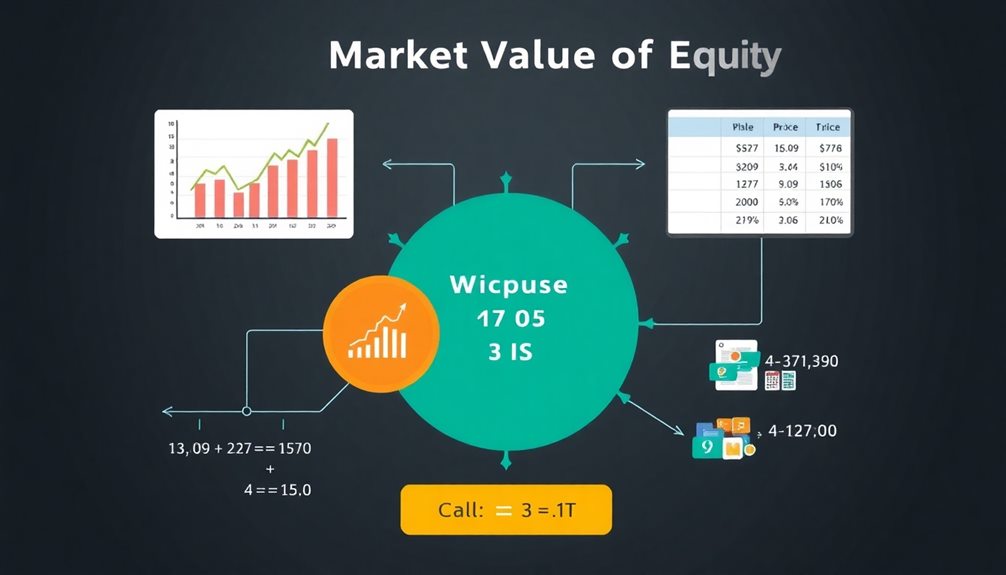
To calculate the market value of equity (MVE), you simply multiply the current stock price by the total outstanding shares. The formula is straightforward: Market Value of Equity = Current Stock Price × Total Outstanding Shares.
It's essential to guarantee that the total outstanding shares reflect all issued shares minus any treasury shares, giving you an accurate figure for your MVE calculation.
Keep in mind that the current stock price is dynamic and can fluctuate daily based on market conditions and investor sentiment. As a result, you should update your MVE regularly to capture these changes.
For instance, if a company's stock price is $50 and there are 1 million total outstanding shares, the market value of equity would be $50 million (50 × 1,000,000).
You can also express MVE on a per-share basis, which helps you assess the value of an individual share in relation to the company's overall market capitalization.
This approach provides valuable insights, especially when comparing different companies or evaluating investment opportunities.
Accurate MVE calculations can guide your financial decisions and investment strategies effectively.
As an affiliate, we earn on qualifying purchases.
Key Components

Key components of the market value of equity (MVE) provide essential insights into a company's financial standing.
To calculate MVE, you multiply the current stock price by the total diluted shares outstanding, which is also referred to as market capitalization. This total includes all issued shares, accounting for stock options and convertible securities that may impact the overall calculation.
The current stock price reflects the latest market transactions and can change frequently due to investor sentiment and varying market conditions. Consequently, it's vital to stay updated on stock prices to guarantee accurate MVE calculations, typically performed during trading hours.
Understanding these components helps you gauge the company's financial health and growth potential. A higher MVE indicates a strong investor perception and suggests the company has solid equity backing.
Conversely, a declining MVE may signal concerns about the company's future prospects. By focusing on these key elements, you can better assess the market value of equity and make informed investment decisions.
As an affiliate, we earn on qualifying purchases.
Factors Influencing Market Value

Market value of equity (MVE) is influenced by various factors that can shift rapidly, impacting a company's perceived financial health. Economic conditions, like recessions or growth periods, greatly affect investor sentiment, leading to fluctuations in MVE. When the economy is strong, investors may perceive a company's cash flow as stable, increasing its market value. Conversely, during downturns, fear can drive stock prices down.
Industry trends also play an important role. Technological advancements or regulatory changes can swiftly alter how shares are valued in the market. Company-specific events, such as earnings reports or product launches, further influence investor perceptions, often resulting in immediate shifts in MVE.
Moreover, investor behavior is essential. Psychological factors and herd mentality can lead to market overreactions, causing short-term fluctuations in MVE that don't always reflect the company's long-term value. Analyst recommendations and overall market sentiment can sway investor confidence, affecting demand for a company's stock.
All these elements intertwine, making it clear that MVE isn't static; it's a dynamic reflection of multiple influences within and outside the company, resonating with its true value in the market.
Comparison With Other Valuation Metrics
When you compare Market Value of Equity (MVE) to other valuation metrics, you'll see important differences that can shape your investment decisions.
MVE contrasts sharply with Book Value, reflecting current market perceptions rather than historical costs.
Additionally, understanding how MVE relates to Enterprise Value and the Price-to-Earnings (P/E) ratio can provide deeper insights into a company's true worth.
MVE vs. Book Value
Understanding the differences between MVE and Book Value is essential for savvy investors maneuvering the complex landscape of valuation metrics. Market Value of Equity (MVE) indicates the current value of a company's equity, calculated by multiplying the market price per share by total outstanding shares. In contrast, Book Value represents the historical cost of a company's assets minus its liabilities.
Here's a quick comparison:
| Aspect | Market Value | Book Value |
|---|---|---|
| Calculation | Price per share x Total outstanding shares | Total assets – Total liabilities |
| Influence | Market conditions, investor sentiment, company performance | Historical costs, accounting measures |
| Volatility | Fluctuates markedly | More static and less volatile |
| Insight | Market expectations, growth potential | Financial health baseline |
| Example | Reflects current market conditions | Indicates intrinsic value in liquidation |
In healthy companies, MVE typically exceeds Book Value due to optimism about future growth. While Book Value provides a solid baseline, it's vital to analyze MVE to gauge investor perceptions and future opportunities.
MVE and Enterprise Value
MVE and Enterprise Value (EV) serve different purposes in evaluating a company's financial health, but both are essential in the investment decision-making process. The Market Value of Equity is calculated by multiplying the current stock price by the total diluted shares outstanding, giving you a clear snapshot of the equity available to shareholders.
In contrast, Enterprise Value offers a broader perspective, combining MVE with total debt and subtracting cash and cash equivalents. This calculation provides a thorough view of the company's overall worth, including its financial obligations.
While MVE focuses solely on equity, EV is particularly useful for determining acquisition costs, as it encompasses all aspects of a company's value. Because MVE often reflects market sentiment and conditions, it tends to be higher than Book Value.
On the other hand, EV provides a more stable valuation by accounting for liabilities, making it an important metric for investors. Analysts commonly use both MVE and EV alongside other metrics, like the Price-to-Earnings (P/E) ratio, to conduct detailed financial analyses and compare companies within the same industry, ensuring a well-rounded investment evaluation.
MVE and P/E Ratio
Often, investors rely on the Price-to-Earnings (P/E) ratio alongside Market Value of Equity (MVE) to gain a deeper understanding of a company's valuation. The P/E ratio is calculated by dividing the market value of equity by the company's earnings per share (EPS), revealing how much investors are willing to pay for each dollar of earnings. A high P/E ratio might signal that a stock is overvalued or that investors anticipate significant growth, while a low P/E could suggest undervaluation or sluggish growth expectations.
While MVE reflects the current market sentiment and is influenced by various external factors, the P/E ratio provides a dynamic view of valuation by incorporating earnings potential. By comparing MVE and P/E ratios across companies in the same industry, you can uncover differences in growth expectations and risk assessments among investors.
Ultimately, while MVE offers a snapshot of a company's total equity value, the P/E ratio adds depth by considering its earnings performance. Together, these metrics form a thorough toolkit for financial analysis, helping you make more informed investment decisions.
Market Capitalization Levels

When you look at market capitalization levels, you'll notice distinct characteristics among different categories.
Large Cap companies offer stability, while Mid Cap firms strike a balance between growth and risk.
On the other hand, Small Cap investments can be riskier but might yield significant rewards, so knowing these differences can help you make informed decisions.
Large Cap Characteristics
Large cap companies, with market capitalizations exceeding $10 billion, represent a significant segment of the investment landscape. Their size and stability often lead to inclusion in major stock indices like the S&P 500 or FTSE 100, boosting their visibility and attractiveness to investors.
You'll find that these companies tend to have less volatility compared to mid-cap and small-cap stocks, making them a safer bet during economic downturns.
The financial health of large cap companies is typically robust, characterized by consistent revenue growth and a strong track record of paying dividends. This makes them appealing to income-focused investors seeking reliable returns.
When you look at a large cap company's share price, it's generally supported by a substantial number of shares outstanding, which helps provide liquidity in the market.
Additionally, due to their size, these companies enjoy greater access to capital markets. This access allows them to pursue growth opportunities through acquisitions and strategic investments, enhancing their long-term viability.
Mid Cap Advantages
Mid cap companies, typically valued between £500 million and £2 billion, strike a unique balance between growth and stability in the investment landscape. These firms often have strong growth potential, offering higher growth rates than large cap firms, which makes them appealing for investors looking for capital appreciation.
While they provide attractive investment opportunities, mid cap stocks tend to be less volatile than small caps. This means you can enjoy a smoother investment experience during market fluctuations.
Additionally, mid cap companies generally have better access to capital markets and resources compared to their smaller counterparts. This access allows them to make strategic investments and expand their operations effectively, enhancing their total value over time.
As you consider your investment options, keep in mind that historically, mid cap stocks have outperformed both large and small cap stocks over long investment horizons.
With their attractive market value and potential for strong returns, investing in mid cap companies can be a smart choice, especially if you're looking for a balance between risk and reward. Plus, they often offer appealing stock options, making them a solid addition to your portfolio.
Small Cap Risks
Investing in small cap stocks can be appealing due to their growth potential, but it's important to recognize the accompanying risks. Small cap companies, typically with a market value under £500 million, often exhibit higher volatility compared to larger firms. This volatility means you might see significant price fluctuations, driven by lower trading volumes. As a result, small cap stocks are more susceptible to market sentiment and external economic factors, which can amplify investment risks.
Additionally, when managing your investments, it's essential to understand your overall financial picture and consider options like creating a retirement savings plan to guarantee long-term stability.
Liquidity challenges also play an important role in small cap investing. When you're looking to sell, you may find it difficult to do so without impacting the stock price dramatically. This means you should be cautious about how many common shares outstanding you're trying to trade.
Moreover, these companies often have limited access to capital markets, which hinders growth opportunities and can increase financial risk during downturns.
Despite these risks, small cap stocks have historically outperformed larger companies over the long term in favorable markets. So, while financial modeling can help assess potential returns, it's critical to weigh these investment risks carefully before diving in.
Strategies to Enhance Market Value

To enhance the market value of equity, companies can adopt several effective strategies that focus on driving growth and fostering investor confidence. One key approach is to consistently improve earnings growth, which boosts investor trust and raises the company's stock price. Engaging in transparent communication and strong investor relations can also positively influence market sentiment.
Another effective strategy is to implement initiatives aimed at innovation and product development. This not only attracts investor interest but also increases the perceived future growth potential, further enhancing the market value of equity.
Additionally, share buybacks can be a powerful tool. By reducing the number of outstanding shares, companies can elevate earnings per share (EPS), which often leads to an increase in market value.
Lastly, maintaining a strong balance sheet with manageable debt levels enhances financial stability, making the company more appealing to investors.
| Strategy | Benefit | Impact on Market Value |
|---|---|---|
| Earnings Growth | Increases investor confidence | Raises stock price |
| Share Buybacks | Reduces outstanding shares | Boosts earnings per share |
| Strong Balance Sheet | Enhances financial stability | Attracts more investors |
Frequently Asked Questions
How to Calculate the Market Value of Equity?
To calculate the market value of equity, you multiply the current stock price by the total outstanding shares. Keep track of the stock price, as it fluctuates frequently based on market conditions.
Where Can I Find a Company's Market Value of Equity?
You might think finding a company's market value of equity is complicated, but it's easy! Check financial news sites like Yahoo Finance, Google Finance, or Bloomberg, or access reports on the SEC's website for accurate information.
What Is the Formula for the Market Value of Equity WACC?
To find the market value of equity using WACC, you won't directly calculate it with a formula. Instead, you assess the overall cost of capital, which impacts your valuation and investment decisions.
How to Calculate Fair Market Value of Equity Shares?
To find the fair market value of equity shares, you'll blend together market capitalization, stock options' fair value, and convertible securities' value. This approach paints a complete picture of a company's worth for potential transactions.
Conclusion
In the world of investing, understanding market value of equity isn't just a number; it's a window into a company's heart. Recognizing how it's calculated and what influences it can empower you to make informed decisions. While market fluctuations can be intimidating, remember that every dip holds the potential for growth. Embrace the journey, and as you enhance your investment strategies, you'll find that the true value lies in the opportunities waiting to be uncovered.
Halloween Picks
halloween
As an affiliate, we earn on qualifying purchases.