

TL;DR

Get smart everyday buys delivered free with Prime
- Fast, free delivery on millions of items
- Prime Video, Amazon Music and more included
- Member-only deals all year
Nvidia shares closed at $168.89 on Nov. 10, down $17.75 from the Nov. 6 close. Applying Nvidia’s reported share count to that price move gives an estimated $428 billion decline in market value; the calculation is not a measure of cash leaving the company. Reporting cited broader pressure on technology stocks as well as Nvidia-specific scrutiny, but the sources do not establish how much each factor contributed.
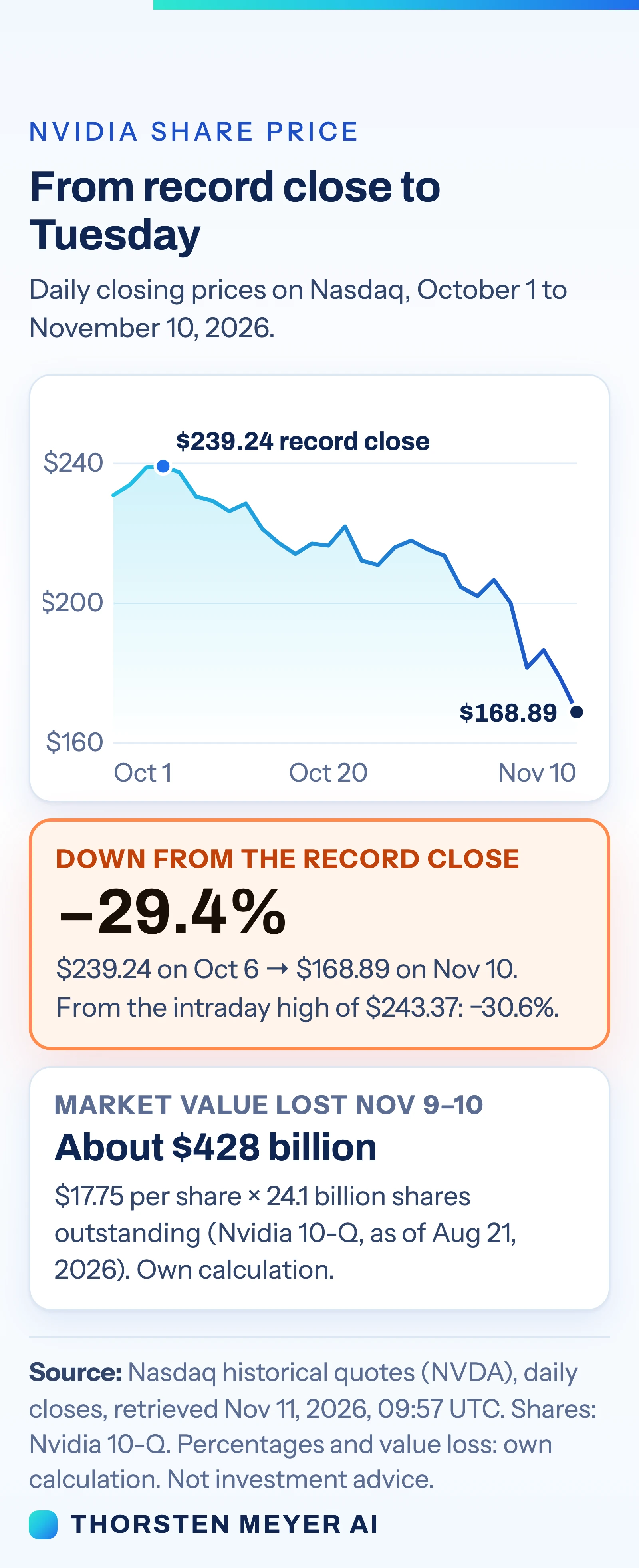
Nvidia shares fell to $168.89 at the close on Tuesday, Nov. 10, after closing at $186.64 on Friday, Nov. 6. The $17.75-per-share decline corresponds to an estimated $428 billion reduction in market value, calculated using Nasdaq closing prices and the 24.1 billion shares outstanding Nvidia reported as of Aug. 21.
The $428 billion figure is an estimate based on a share-price change, not a report that Nvidia lost that amount in cash or revenue. Multiplying the $17.75 decline by the reported 24.1 billion shares produces about $428 billion. The share count is from Nvidia’s latest quarterly filing, while the price comparison uses the closes on Nov. 6 and Nov. 10.
The decline followed a volatile stretch. Nvidia fell 9.26% on Nov. 5, from $200.13 to $181.60, then rebounded 2.78% on Nov. 6 before dropping 4.27% on Nov. 9 and 5.47% on Nov. 10. From its Oct. 6 record close of $239.24 to Tuesday’s close, the stock was down 29.4%, a roughly $1.7 trillion difference in market value using the same share count.
Reports described pressure from both the broader technology market and issues tied specifically to Nvidia. AFP linked sector selling to concern about the pace of data-center construction and reported that an October inflation reading above economists’ expectations lifted rate-hike expectations. Nvidia also faced a board investigation announced Nov. 8, a proposed shareholder class action filed Nov. 9, and scrutiny of a customer over export controls. The available reporting does not assign a precise share of the stock decline to any one factor.
Nvidia’s Weight in Major Indexes
The fall matters beyond Nvidia because the company has a large position in widely followed stock indexes. As of Nov. 9, Nvidia represented 6.64% of the SPY S&P 500 tracker and 7.10% of the QQQ Nasdaq-100 tracker, according to the source material. A sharp move in a heavily weighted company can affect the funds and indexes that hold it, as well as investors who track those benchmarks.
CNBC reported that Nvidia dragged down the three major averages on Tuesday. Reuters also reported that Microsoft briefly overtook Nvidia as the world’s second-most valuable company during the session. AFP said Nvidia was back in second place behind Apple by the close. These reports show how quickly its market ranking can shift as prices move; they do not establish that the company’s operating performance changed by the same amount.
For businesses and users, the stock-price drop is not itself evidence that Nvidia’s products, supply, or customer services have changed. The company’s chips are central to the AI data-center expansion, so questions about spending plans, export controls, and demand can affect expectations for the wider technology industry. Whether those concerns alter Nvidia’s sales or customers’ plans remains to be seen.
Products Worth Considering

Samsung 34-inch ViewFinity S50GC Ultra-WQHD Monitor

Canon PIXMA PRO-200S Wireless Professional Inkjet Photo Printer

Logitech MX Master 4 for Mac Wireless Ergonomic Mouse, White Silver
As an affiliate, we earn on qualifying purchases.
From October’s Record to Tuesday
Nvidia reached a record closing price of $239.24 on Oct. 6. Yahoo Finance reported that the shares settled just below an intraday record that day and that Nvidia’s intraday market value reached $5.84 trillion. The source article’s calculations put Tuesday’s close 30.6% below the Oct. 6 intraday high of $243.37 and 29.4% below the record close.
The latest steep losses came after an earlier retreat. Nvidia closed at $200.13 on Nov. 4, then fell to $181.60 the next day. After Friday’s partial recovery, the share price declined in each of the next two sessions. The source material describes the four-session decline from the Nov. 4 close through Nov. 10 as 15.6%.
The reported market-wide pressures included concern about AI data-center construction after the U.S. midterm elections and uncertainty about the outlook for AI. AFP said fears of slower data-center expansion contributed to heavy selling across the technology sector. The Motley Fool cited expectations that the incoming Congress could be less supportive of unrestricted AI development and said some incoming governors had announced data-center construction moratorium plans. Those are reported concerns and expectations, not confirmation that construction has slowed or that the plans will take effect.
On Tuesday, AFP linked market declines to U.S. inflation data showing prices slowed less than expected in October. CNBC reported that the consumer price index rose 0.4% that month, compared with economists’ expectation of 0.3%, and that the Nasdaq lost 0.7%. Higher interest rates can raise borrowing costs, a factor relevant to capital-intensive data-center projects. The available source material does not quantify how much the inflation report or rate expectations affected Nvidia specifically.
What the Price Drop Cannot Show
The $428 billion estimate depends on a specific price window and share count: the Nov. 6 and Nov. 10 closes and 24.1 billion shares reported as outstanding on Aug. 21. It is an approximate change in market capitalization. It does not show how much investors sold, how much cash Nvidia has, or whether the company’s business value changed by that exact amount.
It is also unclear how much each reported concern contributed to the decline. The source material names broad technology-sector selling, inflation and interest-rate expectations, a board investigation, a proposed shareholder class action, and scrutiny of a customer over export controls. It does not provide a reliable breakdown of their separate effects. The details and outcomes of the investigation, lawsuit, and export-control scrutiny are not fully specified in the supplied reporting.
The source material does not establish whether data-center spending has slowed, whether the concerns about future AI investment will persist, or what the stock will do next. The market figures here are historical through the Nov. 10 close; later trading may change them.
Nvidia’s Nov. 17 Results
Nvidia is scheduled to report its third-quarter results on Nov. 17. Those results will provide a new company update after the period covered by the reported stock decline. Investors and businesses will be able to compare the reported results with the concerns about AI infrastructure demand, while the board investigation, proposed shareholder action, and export-control scrutiny may develop separately.
Until those updates arrive, the reported price move can be described and calculated, but its causes cannot be apportioned precisely from the available material. The next clear milestones are the earnings report and any further public information about the company-specific matters. No outcome or market reaction is established by the sources provided.
Key Questions
How was the estimated $428 billion figure calculated?
The source calculation takes the $17.75 decline per share between the Nov. 6 close of $186.64 and the Nov. 10 close of $168.89, then multiplies it by Nvidia’s reported 24.1 billion shares outstanding as of Aug. 21. The result is approximate and represents a change in market value.
Did Nvidia lose $428 billion in cash?
No. The figure estimates a decrease in stock-market value based on the share-price move and reported share count. It does not mean Nvidia paid out or lost $428 billion in cash.
Why did Nvidia shares fall?
Reporting cited broad pressure on technology stocks, including concern about AI data-center construction and higher interest-rate expectations after an inflation report. It also cited Nvidia-specific matters: a board investigation, a proposed shareholder class action, and scrutiny of a customer over export controls. The sources do not quantify each factor’s contribution.
How far was Nvidia down from its October record close?
At the Nov. 10 close of $168.89, Nvidia was 29.4% below its Oct. 6 record close of $239.24, according to the source calculation. That comparison uses closing prices, rather than the Oct. 6 intraday high.
When is Nvidia’s next scheduled earnings report?
The source material says Nvidia is scheduled to report its third-quarter results on Nov. 17, 2026.
Source: Thorsten Meyer AI