
TL;DR
IdeaClyst acts like a digital war room for your ideas, combining AI-driven debate, structured discovery, and local-first data storage. It helps founders validate, refine, and prioritize ideas efficiently—saving time and money while enhancing confidence.
Imagine having a dedicated, ever-ready war room—your secret weapon—that helps you scrutinize, refine, and validate your next big idea. Not a cluttered physical space, but a sleek, private digital environment on your laptop. That’s what IdeaClyst offers: a place where your ideas get serious, structured attention, without the distractions of email threads or endless spreadsheets.
In this article, you’ll see how IdeaClyst turns the chaos of brainstorming into a clear, confident strategy—fast. Whether you’re a solo founder or part of a small team, understanding this tool could be the difference between building something the market loves or wasting months chasing ghosts.
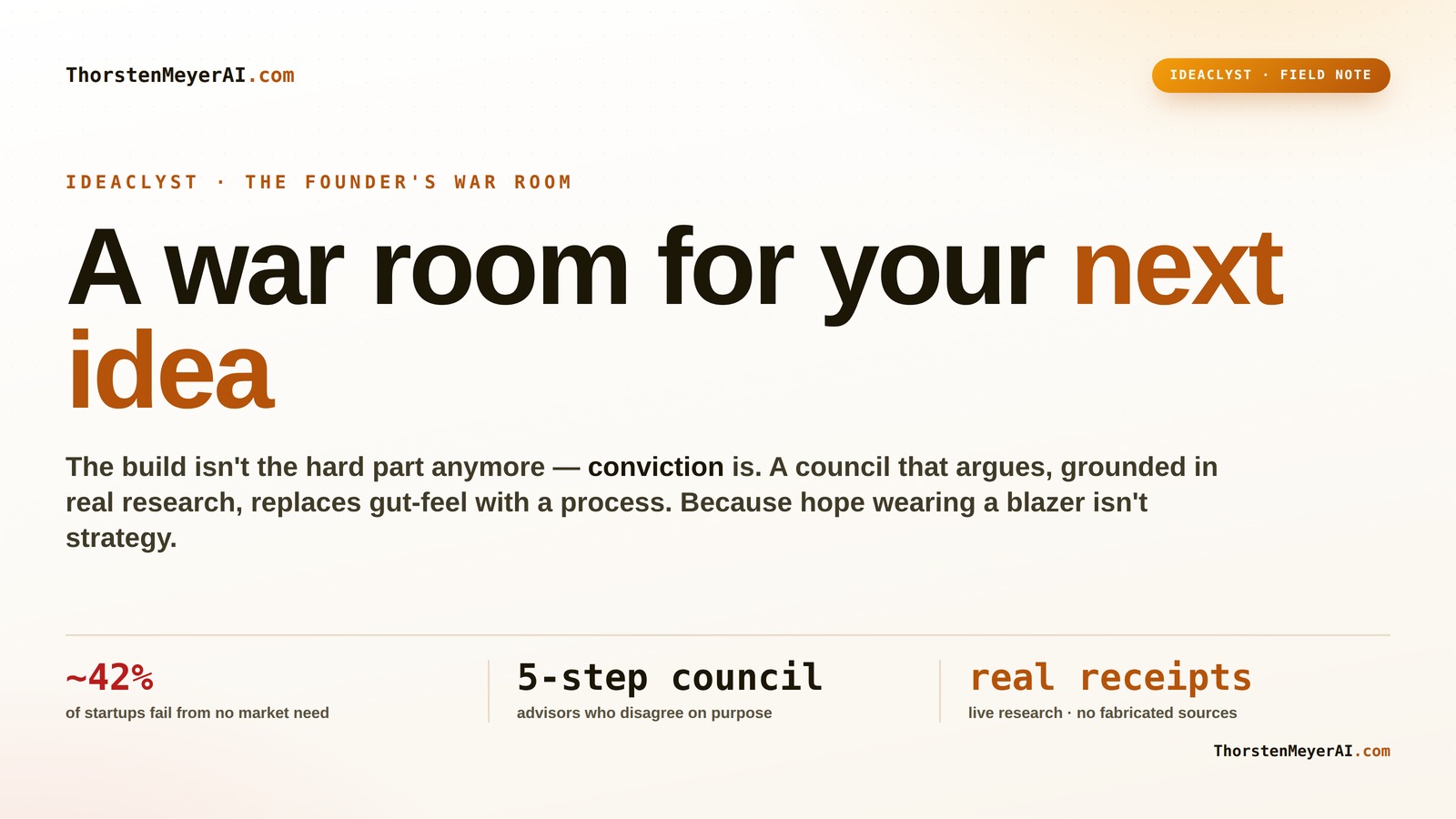
A war room for your next idea
The build isn’t the hard part anymore — conviction is. Knowing which idea deserves the next six months, and being able to defend it. Most founders answer with gut feel and optimistic math. That’s hope wearing a blazer. IdeaClyst replaces it with a process.
The most expensive decision is what to build
The single most valuable thing a tool can do is talk you out of the wrong six months. The numbers make the case better than any pitch.
Three tools in one — on your own machine
Strip away the framing and IdeaClyst is three things at once, all running locally with nothing leaving your laptop.
An AI council
Pressure-tests an idea you bring it — advisors who argue on purpose.
A discovery engine
Finds ideas you didn’t know to look for by hunting real demand signals.
A founder’s workspace
Carries winners from “interesting” all the way to “ready to build.”
Advisors who disagree on purpose
Not one confident, agreeable answer — a structured five-step deliberation where models play different roles and turn on their own work. The disagreement is the feature.
The five-step deliberation
A council that leads with the bad news surfaces the objections you’d otherwise find the expensive way, on month five.
Product strategy
Who’s it for, what’s the wedge, why now, what’s the business model.
Technical architecture
What would it actually take to build — and where’s the risk.
Critique pass
The council turns on its own work. Where’s the hand-waving? What kills this?
Second, independent critique
A different voice, a different angle — so blind spots don’t survive.
Final synthesis
Everything into one coherent founder packet: strategy, architecture, validation, plan.
When IdeaClyst cites a source, it actually fetched it
The hard departure from “ask an AI what it thinks of my startup.” It runs in a strict, real-data-only mode — if it can’t gather genuine evidence, it says so plainly rather than inventing a plausible paragraph.
Confidence with receipts
No fabricated statistics, no imaginary competitors, no made-up citations. The packet survives a skeptical co-founder or a sharp investor because the reasoning has receipts.
Market research first
Scouts the landscape before the council reasons about anything.
Competitor read
Real positioning, pricing signals, feature claims — differentiation vs. reality.
Validation with links
Not “talk to customers” — concrete signals & sources you can click.
From the blank page to build-ready
Evaluation is half the problem; the blank page is the other half. And a plan is worthless if it dies in a tab you never reopen.
Bring a space, not an idea
“AI for accountants,” “tools for indie game studios” — plus your goal and real capacity. It hunts demand signals across HN, Reddit, Product Hunt, GitHub, pricing pages.
- An honest market read — leads with the bad news when a space is hard
- An opportunity map — high pain, thin competition
- Ranked candidates — wedge, who pays, effort, risk, confidence
- each with KILL CRITERIA — when to walk away
A home and a forward path
Every promising idea gets carried forward, with every artifact in plain files on your disk.
- Validation tooling — sprint board, interview list, evidence browser
- Founder profile — a personal-fit lens; same discovery, different advice
- Build workspaces — funnel, personas, landing draft, version history
- “Build this idea” → a PRD + task queue, ready for a coding agent
Key Takeaways
- IdeaClyst acts as a private, local-first digital war room for structured idea validation and development.
- The AI council’s multi-model debate surfaces blind spots and reduces reliance on wishful thinking.
- Grounding ideas in real-time web research cuts down months of validation into hours, saving thousands of dollars.
- Digital war rooms support remote teams better, offering asynchronous collaboration and version-controlled documentation.
- Regular reviews and pruning keep your war room efficient, relevant, and free of clutter.
![DeskFX Free Audio Effects & Audio Enhancer Software [PC Download]](https://m.media-amazon.com/images/I/41fXbDohyuS._SL500_.jpg)
DeskFX Free Audio Effects & Audio Enhancer Software [PC Download]
- Audio Transformation: Enhance sound from speakers and headphones
- Sound Quality Improvement: Adjust audio with various effects
- Audio Control: Manage sound through hardware settings
As an affiliate, we earn on qualifying purchases.
As an affiliate, we earn on qualifying purchases.
What Is IdeaClyst and Why Does It Matter?
IdeaClyst is more than just a brainstorming app. It’s a local-first, open-source system that acts like a digital war room—bringing structured debate, discovery, and planning into one workspace. You bring your idea, and it assembles an AI council that pressures-test your concept from multiple angles—product, tech, risks, and market fit.
What makes it stand out? It’s designed to be your private, offline hub. No cloud account, no data leaks—just plain files on your machine. This focus on privacy and control aligns perfectly with founders who want to keep their early-stage ideas close, while still gaining the benefits of AI-powered critique and collaboration.
Deeply, this setup matters because early-stage ideas are often fragile and vulnerable to leaks or distractions. By keeping everything local, founders can iterate confidently without fearing data breaches or losing control over sensitive concepts. It also means they can work offline, which is crucial in environments with unreliable internet or when privacy is paramount. The tradeoff is that collaboration becomes more manual, but the tradeoff favors security and control for many startups.

HWAYO 2.5'' 1TB Ultra Slim Portable External Hard Drive USB3.0 HDD Storage for PC/Desktop/Laptop/MacBook/Chromebook/Xbox One (Black)
- High-capacity storage: 1TB portable external hard drive
- Fast data transfer: USB 3.0 for quick backups
- Ultra slim design: Compact and lightweight for portability
As an affiliate, we earn on qualifying purchases.
As an affiliate, we earn on qualifying purchases.
Why the ‘War Room’ Model Works for Idea Development
Think of a war room as a strategic HQ: a dedicated space where key decisions happen quickly and visually. In a startup context, it’s about centralizing ideas, feedback, and progress to avoid scattered efforts. IdeaClyst adapts this model digitally, making it accessible anywhere—perfect for remote or hybrid teams.
For example, a SaaS founder used it to rapidly vet a new feature idea. Over a week, they gathered feedback from the AI council, identified technical risks, and mapped out validation steps—all in one shared space. The result? Faster pivoting and clearer priorities.
Deeply, this approach matters because startups often suffer from fragmented communication—teams working in silos, missing critical insights from others. The war room model consolidates these insights into a single, visual, and interactive environment, reducing miscommunication and enabling rapid iteration. The tradeoff? It requires disciplined management to keep the space organized and focused. Without that, it can become cluttered, defeating its purpose. The key is to balance openness with structure, ensuring the war room remains a strategic asset rather than a distraction.

Building AI-Powered Products: The Essential Guide to AI and GenAI Product Management
As an affiliate, we earn on qualifying purchases.
As an affiliate, we earn on qualifying purchases.
How IdeaClyst Supports Your Idea From ‘Interesting’ to ‘Ready to Build’
IdeaClyst guides your idea through five structured steps—like a strategic drill sergeant—making sure nothing slips through the cracks. Here’s how it works: Learn more about digital war rooms.
- Idea Input: Write your initial thought or ambition. This step is critical because clarity at the start sets the tone for effective validation. Vague ideas lead to ambiguous debates; precise inputs enable targeted critique.
- Council Debate: Multiple AI models argue for and against your idea, exposing blind spots. This stage is vital because diverse perspectives—simulated by AI—highlight risks and assumptions you might overlook, fostering a more balanced view.
- Research Grounding: It pulls in live web data to verify assumptions—no more guessing. This step matters because relying solely on internal knowledge risks confirmation bias. By integrating real-time data, you ground your ideas in current market realities, reducing costly missteps.
- Critique & Refinement: The council digs into risks, unproven assumptions, and market fit. This iterative scrutiny is essential to evolve fuzzy concepts into robust plans, balancing optimism with skepticism to avoid premature scaling or pivoting too late.
- Final Plan: You get a structured report with clear next steps, validation tests, and strategic notes. This documentation ensures accountability and clarity, making it easier to mobilize resources or communicate with stakeholders.
This process transforms vague, aspirational ideas into evidence-backed, actionable plans—reducing the guesswork and aligning team efforts with validated insights. The tradeoff is that it requires disciplined input and ongoing research, but that investment pays off by increasing confidence and reducing costly rework later.

Software Verification and Validation: Realistic Project Approaches
As an affiliate, we earn on qualifying purchases.
As an affiliate, we earn on qualifying purchases.
Frequently Asked Questions
What exactly is IdeaClyst?
IdeaClyst is a local-first, open-source system that acts as a digital war room—combining AI-driven debate, real-time web research, and structured documentation to help founders validate and develop ideas efficiently.Do I need a physical space for a war room, or can it be digital?
While physical war rooms foster face-to-face collaboration, digital versions like IdeaClyst are often more practical today. They support remote teams, asynchronous feedback, and faster iteration—making them ideal for modern startups.How does the AI council improve idea validation?
The AI council stages structured debates, with multiple AI models taking different roles—such as product, tech, and risk. Their disagreements surface blind spots and unproven assumptions, reducing costly mistakes and building confidence in your plans. Discover more about AI-powered idea validation.What should I include in my war room setup?
Include idea logs, research trackers, critique templates, and progress boards. Use Markdown files or digital tools like Trello for visualization. The key is keeping everything visible, organized, and regularly updated.How often should I review my war room?
Set a recurring schedule—weekly or bi-weekly—to prune outdated ideas, update research, and challenge assumptions. This keeps your war room lean, relevant, and a true strategic asset.Conclusion
Think of IdeaClyst as your secret strategic HQ—on your laptop, always ready to challenge, refine, and validate your ideas. It’s more than a tool; it’s a mindset shift for smarter, faster creation.
If you want to turn fuzzy ambitions into confident plans, start building your own digital war room today. Your next breakthrough might just depend on it.