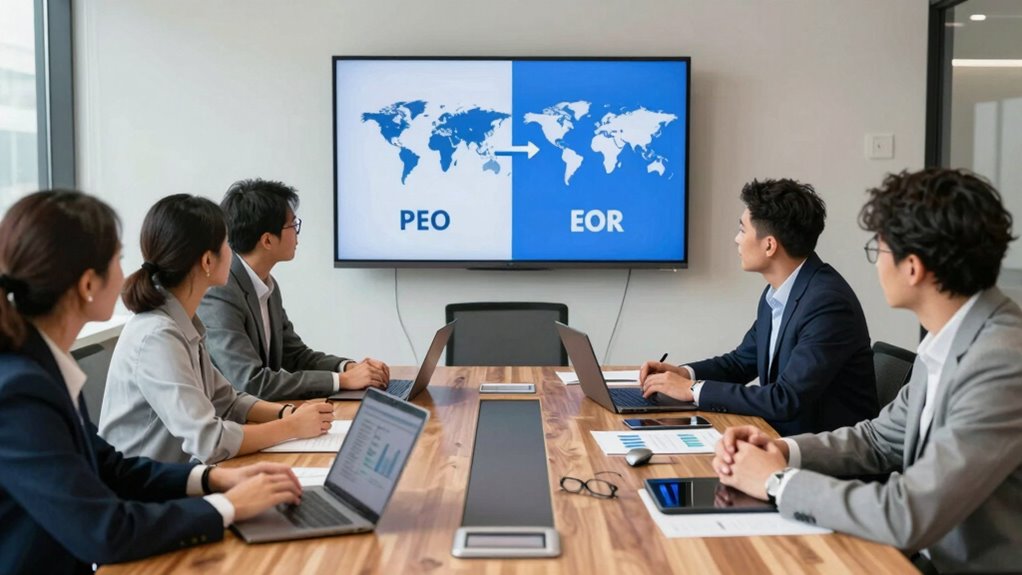

When deciding between a PEO and an EOR for global hiring, you’ll want to weigh control versus compliance. A PEO lets you manage day-to-day HR and hiring, but legal responsibilities are shared, which can be tricky across borders. An EOR takes full legal responsibility, making compliance easier but limiting your control. Choosing the right model is essential to avoid legal pitfalls and operational hiccups as you grow internationally. Keep going to discover how to make the best choice for your team.

Get smart everyday buys delivered free with Prime
- Fast, free delivery on millions of items
- Prime Video, Amazon Music and more included
- Member-only deals all year
Key Takeaways
- EOR acts as the sole legal employer, simplifying compliance and onboarding, ideal for quick market entry or testing new regions.
- PEO allows shared employment responsibilities, offering control over management but requiring awareness of legal boundaries.
- Choosing EOR minimizes legal risks by handling all employment formalities, while PEO requires managing day-to-day HR within legal limits.
- Clear understanding of local labor laws is crucial to avoid compliance pitfalls with either model.
- Proper selection between PEO and EOR enhances operational efficiency and supports smooth international scaling.

Expanding your team internationally can be exciting, but it also introduces complex legal and operational challenges. When you’re trying to hire talent across borders, understanding the differences between a Professional Employer Organization (PEO) and an Employer of Record (EOR) becomes essential. These options are often confused, but they serve distinct purposes, especially when it comes to employee onboarding and legal compliance. Your goal is to navigate these differences smoothly so you can grow without running into legal pitfalls or operational setbacks.
A PEO typically acts as a co-employer, handling payroll, benefits, and HR administration for your employees. You still maintain control over day-to-day management and hiring decisions, but the PEO manages the legal side of employment, ensuring compliance with local labor laws. This setup simplifies employee onboarding because the PEO takes care of paperwork, tax withholding, and benefits setup, creating a seamless process for your new hires. However, because you’re sharing employment responsibilities, you need to understand the legal boundaries and reporting obligations involved to avoid compliance issues. You retain authority over job roles and performance, but the PEO handles the formalities of employment law adherence. Legal compliance is a crucial aspect that both models aim to simplify, but the way they do so varies significantly. Additionally, understanding compliance management can help you better anticipate potential legal risks and ensure smooth operations. Recognizing the importance of local labor laws can also prevent costly misunderstandings and penalties down the line. Moreover, leveraging local labor law expertise can further reduce the risk of non-compliance and legal disputes.
In contrast, an EOR acts as the sole legal employer in the country where your employee works. When you hire through an EOR, you delegate all employment responsibilities—payroll, taxes, benefits, and legal compliance—to this third party. This considerably streamlines employee onboarding, as the EOR takes charge of all legal paperwork, ensuring that employment contracts meet local standards and regulations. The EOR also handles ongoing legal compliance, helping you avoid costly penalties or misunderstandings related to local labor laws. This setup is especially useful if you’re testing new markets or want to hire quickly without establishing a local entity. You get to focus on managing your team’s performance and productivity, knowing that the legal and operational complexities are taken care of. Additionally, digital content plays a crucial role in streamlining international hiring processes and compliance management.
Choosing between a PEO and an EOR depends on your specific needs. If you want a co-employment model that allows you to retain some control, a PEO might be the right fit. If you prefer to offload all legal employment responsibilities and simplify the onboarding process, then an EOR is likely the better choice. Either way, understanding how each model handles legal compliance and employee onboarding helps you make smarter decisions, avoid legal risks, and scale your team efficiently across borders.
Products Worth Considering

Apple Mac mini (2026) with M5 Pro chip

Logitech MX Master 4 for Mac

FLEXISPOT 36-Inch Height-Adjustable Standing Desk Converter, Black
As an affiliate, we earn on qualifying purchases.
Frequently Asked Questions
How Do PEO and EOR Differ in Legal Liabilities?
You need to understand that PEOs assume most legal obligations, handling liability management for employment-related issues, while EORs act as the legal employer, bearing primary legal liabilities. With a PEO, your company stays more involved in compliance, but the PEO manages legal risks. Conversely, an EOR takes on full legal liability, reducing your exposure but also limiting your control over employment practices.
Which Option Offers Better Compliance in Multiple Countries?
You’ll find that an EOR generally offers better compliance across multiple countries because they directly manage local employment regulations and guarantee tax compliance. With an EOR, you avoid the pitfalls of non-compliance, as they handle legal requirements, payroll, and taxes for your international employees. This helps you focus on scaling without worrying about intricate local employment laws, giving you peace of mind in multiple jurisdictions.
Can PEOS and EORS Handle Complex Employee Benefits?
Yes, both PEOs and EORs can handle complex employee benefits, but their capabilities vary. They manage employee onboarding and benefits administration efficiently, ensuring compliance with local regulations. PEOs often offer more extensive benefits packages, while EORs focus on compliance and payroll. You should consider your specific needs—if you require tailored benefits, a PEO might be better, but for quick onboarding and compliance, an EOR is often more suitable.
What Are the Typical Costs Associated With Each Option?
Cost comparison can be confusing, so let’s break down expenses. PEOs typically charge a percentage of payroll plus additional fees, making costs predictable yet potentially pricey. EORs often have a straightforward service fee that covers legal compliance, payroll, and benefits. An expense breakdown reveals PEOs might offer bundled benefits at a higher cost, while EORs tend to provide transparent, pay-as-you-go pricing, helping you better balance budgets and plan for scalable growth.
How Quickly Can Each Solution Be Implemented Globally?
You can typically implement EOR solutions quickly, often within days, thanks to their streamlined setup. PEOs may take longer, as they require more extensive remote onboarding and cultural integration processes across different regions. Both options aim to facilitate rapid global hiring, but EORs offer a faster route for immediate deployment. Keep in mind, smooth remote onboarding and cultural integration are essential for successful international team scaling.
Conclusion
Choosing between a PEO and an EOR can feel like steering through a maze, but remember, your decision shapes your team’s future. Imagine trying to assemble a puzzle blindfolded—without the right piece, the picture stays incomplete. In 2022, over 60% of scaling companies reported delays due to missteps in global hiring. So, take off the blindfold: understanding these options guarantees your team’s growth isn’t just a shot in the dark but a clear path forward.