
TL;DR

Get smart everyday buys delivered free with Prime
- Fast, free delivery on millions of items
- Prime Video, Amazon Music and more included
- Member-only deals all year
Anthropic’s $65 billion Series H isn’t just a valuation milestone; it’s a huge bet on AI infrastructure—chips, cloud, memory, and power. The round signals that compute supply chains now set the pace for AI progress, not just the models themselves.
When a company hits a $965 billion valuation, it’s tempting to see it as just another headline. But behind the numbers lies a story about the future of AI infrastructure. This isn’t a typical funding round; it’s a massive commitment to the hardware and cloud capacity that powers AI models like Claude.
Think of it as a giant investment in the roads, bridges, and powerplants that will carry AI’s growth for years. Anthropic’s move signals that AI’s bottleneck isn’t just the algorithms anymore—it’s the chips, memory, and cloud infrastructure. This article breaks down what this round really means for AI, tech supply chains, and the industry’s next chapter.
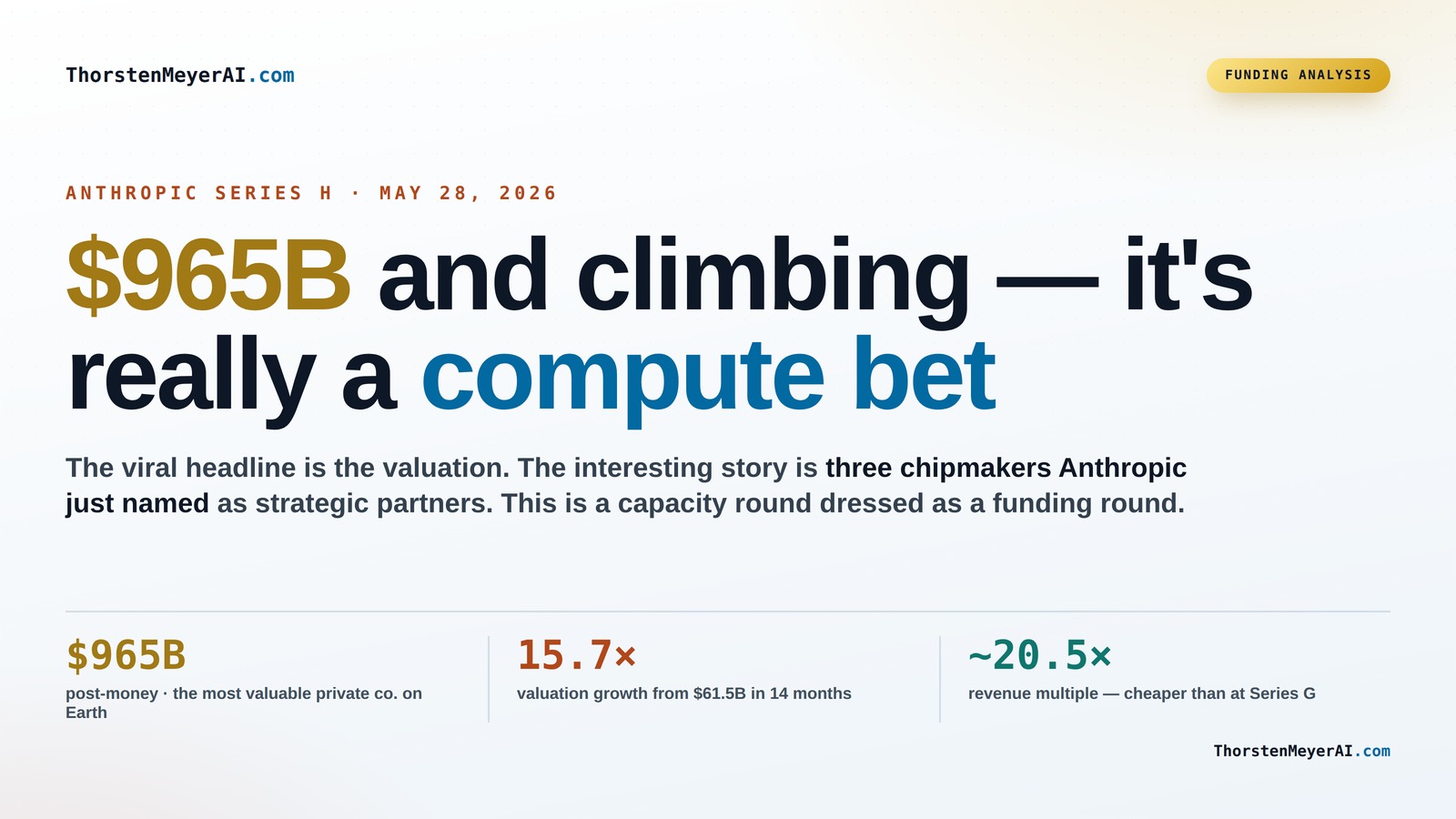
$965B and climbing — it’s really a compute bet
The viral headline is the valuation. The interesting story is in the press release’s middle paragraphs — and in three chipmakers Anthropic just named as strategic partners. This is a capacity round dressed as a funding round.
The numbers nobody can quite parse in sequence
Read together they describe a trajectory with no precedent in enterprise software. Read individually, each looks like a typo.
From $61.5B to $965B in fourteen months
Salesforce took roughly two decades to reach revenue numbers Anthropic just blew past. The sequence below is the part most coverage skips — it’s not the size, it’s the shape.
Anthropic’s valuation ladder · Mar 2025 → May 2026
Five rounds, fourteen months. Bar height is the valuation; the climb itself is the story. Tap any milestone for context.
The multiple actually got cheaper
Bubbles look like multiples expanding while revenue lags. Anthropic’s pattern is the inverse — the valuation tripled, but revenue grew faster, and the multiple compressed.
Revenue-to-valuation multiple · Series G → Series H
Same company, three months apart. The denominator (revenue) is outrunning the numerator (valuation) — exactly the opposite of what a bubble narrative predicts.
10+ gigawatts and three chipmakers
When you name Micron, Samsung & SK hynix alongside your equity backers, you’re saying the binding constraint isn’t demand or model quality — it’s the physical supply of memory chips. The Series H is a capacity round.
Compute commitments backing Anthropic’s capacity bet
$200B+ in announced compute spend across multi-year contracts. The $65B Series H raise has to be read against that bill, not against operating losses.
A genuinely durable bet — or a structural exposure?
Both readings can be true at once. The answer arrives over the next 18–24 months as the gigawatts come online and either fill with paying demand or don’t.
Revenue growth has no precedent in B2B software ($1B → $47B in 17 months). The multiple is compressing, not expanding. Claude is the only frontier model on all 3 major clouds. Enterprise AI spend share went from ~10% to >65% in a year. Compute commitments are tied to specific contracts with capacity dates.
20× revenue is not cheap by any historical software-investing standard. Revenue is reported gross of cloud-reseller pass-throughs, which inflates the top line. Profitability is 2 years out. Amodei’s own warning: a 12-month delay in AI progress “would make him bankrupt” — the compute commitments are a structural exposure to demand persistence.
The valuation race — and the IPO context
Anthropic shipped Opus 4.8 the same morning as Series H — not a coincidence. One week after OpenAI filed confidentially for IPO. The late-2026 frame is set: two frontier AI companies racing to public markets, each pitching durability.
Key Takeaways
- Anthropic’s $965B valuation is driven more by infrastructure commitments than just market hype, signaling a focus on hardware, cloud, and memory investments.
- The round’s rapid revenue growth has actually reduced the company’s revenue multiple, showing strong enterprise demand for AI at scale.
- Major chipmakers and cloud providers are now strategic partners, not just vendors, shaping AI’s supply chain and competitive landscape.
- This funding shift suggests future AI growth depends heavily on securing massive compute capacity, not just model innovation.
- Investors are betting on infrastructure as the real bottleneck—meaning hardware and supply chains will define AI’s trajectory in the coming years.
As an affiliate, we earn on qualifying purchases.
How a $965B valuation is really a compute infrastructure investment
Anthropic’s $65 billion raise isn’t just about getting more cash. It’s a strategic push into the hardware and cloud capacity needed for training and running massive AI models. This is why the phrase ‘compute deal in disguise’ captures its essence.
Imagine trying to build a skyscraper. You could stop at the design— but without the concrete, steel, and cranes, it’s just a plan. Similarly, Anthropic is pouring money into GPUs, memory chips, data centers, and power infrastructure to scale AI at an unprecedented pace.
For example, the company has secured commitments for over 10 gigawatts of compute—enough to power hundreds of thousands of high-end GPUs running 24/7. That’s like building a small city dedicated to AI processing. When you think of it this way, the round is less about company valuation and more about building the backbone for AI’s next era.
Why does this matter? Because the true challenge in AI isn’t just developing models but maintaining the infrastructure to run them reliably and at scale. This infrastructure investment represents a tradeoff: massive upfront costs and complexity, but the potential to unlock AI capabilities that are impossible without such scale. It signals a shift where hardware and supply chain resilience become the defining factors of AI progress, rather than just algorithmic innovation.

As an affiliate, we earn on qualifying purchases.
Why the ‘multiple’ got cheaper even as valuation soared
It sounds counterintuitive: a company’s valuation tripled, yet its revenue multiple shrank from 27× to 20.5×. How does that happen? The key is rapid revenue growth—Anthropic’s revenue exploded from $9 billion at the end of 2025 to over $47 billion this month.
This surge means investors are paying less relative to what the company earns. It’s like buying a house that just doubled in value but also doubled its rent income—the price per dollar of revenue actually drops.
Compared to OpenAI’s 65× revenue multiple, Anthropic’s 20.5× shows that it’s becoming a more practical investment, not just a hype bubble. The real story: revenue growth is outpacing valuation, signaling strong demand for AI capabilities and infrastructure.
What does this imply? It indicates that the market is recognizing the importance of revenue generation and operational scale over speculative valuation. This shift could lead to more sustainable investment patterns. However, it also raises questions about whether valuations will continue to be justified as infrastructure costs rise, and how companies will balance growth with profitability in this new environment.

high performance AI memory modules
As an affiliate, we earn on qualifying purchases.
As an affiliate, we earn on qualifying purchases.
What does ‘compute-heavy’ really mean for AI companies?
When people say a funding round is ‘really a compute deal,’ they mean the money is mainly for hardware and cloud capacity. For Anthropic, this means buying thousands of GPUs, vast amounts of memory, and power infrastructure to keep AI training and inference humming.
For example, the company’s commitments include partnerships with chipmakers like Micron, Samsung, and SK hynix, plus cloud giants like Amazon, Microsoft, and Google. This isn’t just about buying hardware; it’s about securing an entire supply chain—chips, memory, data centers, power plants—that makes AI scaling possible.
Imagine trying to train a model like Claude. It requires hundreds of thousands of GPUs running in parallel, with fast storage and reliable power. Without this infrastructure, AI progress hits a wall. This round is the industry’s way of building that wall—big, expensive, and critical.
The deeper implication is that the bottleneck for AI progress is shifting from algorithmic innovation to physical infrastructure. The ability to secure and scale this infrastructure determines who can lead in AI development. This creates a tradeoff: companies that can afford this upfront investment will have a significant competitive advantage, but it also means longer timelines and higher risks for startups without access to such resources.

As an affiliate, we earn on qualifying purchases.
The strategic role of chipmakers and cloud giants in the AI race
Anthropic’s round highlights the importance of hardware suppliers and cloud providers in AI’s future. The involvement of Micron, Samsung, SK hynix, and hyperscalers like Amazon shows that these companies are now key players, not just suppliers.
For instance, Amazon’s $5 billion commitment signals a focus on massive cloud capacity, while memory chipmakers ensure the AI models have the fast, reliable storage they need. These relationships are less about a quick sale and more about long-term infrastructure dominance.
Think of it as a chess game. The AI startup isn’t just moving its pieces; it’s securing the entire board—chips, cloud, power, and storage—making it hard for competitors to catch up. This strategic positioning might define who leads AI in the next decade.
Why does this matter? Because these partnerships determine the pace and scale of AI deployment. When hardware supply chains are controlled by a few key players, it can lead to bottlenecks, higher costs, and strategic vulnerabilities. Conversely, it can also create barriers to entry for smaller competitors, consolidating industry power among a few giants. The implications are profound: the future of AI isn’t just about algorithms, but about who controls the physical and logistical backbone supporting these models.

What this means for the AI industry and future funding
Anthropic’s funding signals a shift: AI companies will need to spend billions just to keep up. The focus isn’t only on developing better models but on securing the infrastructure to run them at scale.
For example, this could mean more mega-rounds aimed at infrastructure—think billions for GPUs, data centers, and networking. It also pushes the industry toward a model where hardware and supply chains become the new battleground.
Furthermore, the rapid revenue growth suggests enterprise demand for AI is finally hitting a tipping point. Companies are increasingly willing to invest in the necessary infrastructure to deploy AI solutions at scale, recognizing that without the physical resources, their AI ambitions are limited. This creates a feedback loop: as infrastructure costs rise, only those with significant capital can compete effectively, potentially leading to a consolidation in the industry. This trend might also influence startups’ strategies, pushing them to partner early with hardware providers or focus on niche markets that can afford the infrastructure costs.

What questions remain about Anthropic’s valuation and future
Many wonder: is this valuation sustainable? Or is it driven by hype? The truth is, Anthropic’s rapid revenue growth makes it more than just a hype play. But the high valuation still raises questions about profitability and long-term viability.
Another concern: how much of the $65 billion is new cash versus committed infrastructure spending? The answer: a significant part is pre-arranged hardware and cloud commitments, which could accelerate AI deployment but also inflate the headline numbers.
Finally, this raises broader questions—will Anthropic go public at this valuation? Or is this a strategic move to lock in infrastructure dominance before an IPO? Only time will tell, but it’s clear that the real value now lies in the physical, not just the financial.
In essence, while the valuation is eye-catching, the true test will be whether Anthropic can translate its infrastructure investments into sustainable, profitable growth. The industry must weigh whether these valuations reflect genuine future earnings or speculative hype rooted in the race for physical dominance in AI infrastructure.
Conclusion
What really makes Anthropic’s $965 billion valuation stand out isn’t just the number. It’s the clear message: AI’s next big leap depends on building the hardware backbone—think chips, memory, and cloud capacity—at a scale never seen before.
This isn’t just about funding a company; it’s about funding the entire infrastructure that will power AI’s future. As you watch the industry, remember: the real race is now for the physical resources that make AI possible.

Halloween Picks
halloween
As an affiliate, we earn on qualifying purchases.