
TL;DR
Threlmark treats on-disk JSON files as the single source of truth, enabling offline use, easy synchronization, and full transparency. This simple, file-based approach challenges conventional database reliance and enhances resilience and control.
Imagine a project management tool that works entirely offline, keeps your data transparent and portable, and requires no server at all. That’s what Threlmark does, leveraging a file-based approach. It’s a different way to think about data, where your disk isn’t just storage — it’s the contract, the API, and the single source of truth.
In this article, you’ll see how Threlmark’s architecture turns the idea of “disk as the contract” into a practical, powerful reality. We’ll unpack how plain JSON files on your disk power everything — from speed and resilience to collaboration and AI automation. If you’re tired of opaque databases and want a clear, flexible approach, this deep dive is for you.
Disk is the contract: inside a local-first roadmap hub
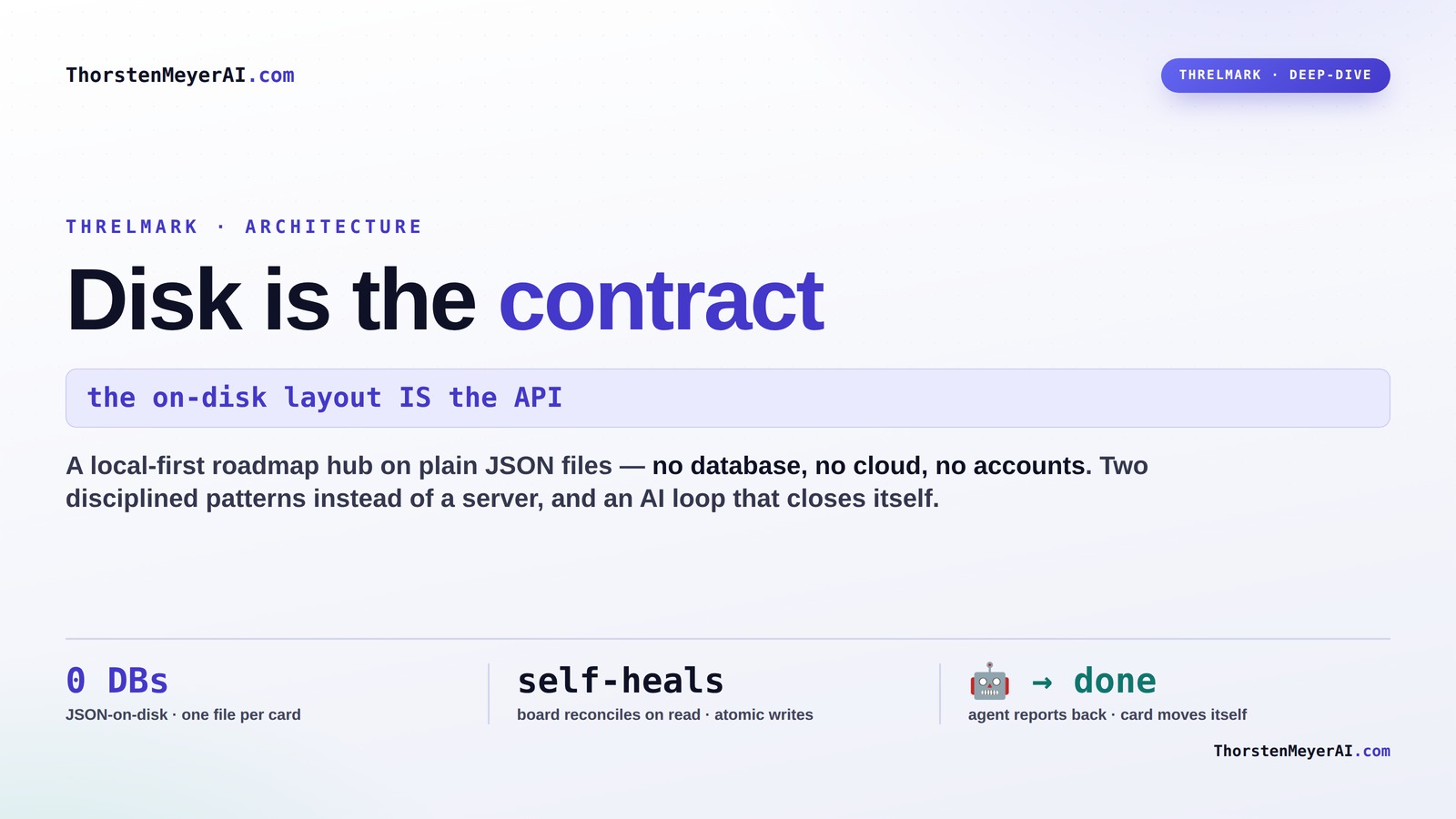
A Next.js app on top of plain JSON files — no database, no cloud, no accounts. The key decision: the on-disk layout IS the API. Everything else cascades from taking that seriously.
There is no server-of-record — the files are the record
The UI and any external tool reach the same files through the same discipline. The data root defaults to ~/.threlmark — home-based, because it’s a shared hub every one of your apps points at.
Inspectable
Every artifact is a file you can cat, diff, grep, commit.
Portable · no lock-in
Back up with cp, sync with Dropbox / git, migrate trivially.
Interoperable
Any tool in any language joins by reading / writing files.
Restartable
No in-memory state to lose — stateless over the files.
Two disciplined patterns instead of a database
“Just use files” is easy to get wrong. These two patterns — ported from a battle-tested sibling app — are what make file-based state sound rather than reckless.
Atomic writes
Write to a temp file in the same dir, then rename() over the target. Rename is atomic on one filesystem — a crash mid-write leaves the complete old file or the complete new one, never a half.
The board heals itself
A single roadmap.json array races when two tools write at once. One file per card makes writes collision-free. Lane order lives in board.json and reconciles on read.
board.json. It writes an item file — the board fixes itself on Threlmark’s next read. Unknown keys are preserved, so the contract is forward-compatible.The numbers can’t drift from the files
Anything computable from item state is computed — so the displayed numbers can never disagree with the underlying JSON. Priority is the clearest example: it’s calculated on read, never persisted.
priority — computed on read
Impact weighted heaviest; effort the only axis that subtracts. Reused verbatim from the original tool, so imported cards rank identically.
A handoff is a first-class flow event
The genuinely 2026-shaped part: most building is done by AI agents, so Threlmark closes the loop. Watch a card go from ranked to Done without anyone dragging it.
Handoff → report → self-move
The brief carries a reporting protocol. The agent reports through REST or the filesystem — and a done report moves the card itself.
POST /api/projects/:id/
items/:itemId/report
Direct call. Applied immediately.
drop reports/<file>.json
→ ingested on read
Robust even if the server’s down at finish time.
A small formula, and an honest hosting caveat
Because items are globally addressable (<projectId>/<itemId>), the Portfolio ranks everything together by a status-weighted score — finishing beats starting, blockers get a boost.
Portfolio ranking — status-weighted
In-flight work floats to the top; bottlenecks cost the most, so blockers get nudged up.
Static read-only demo
Seeded data, writes to localStorage. Try-before-you-clone.
Personal Node instance
Password-gated, persistent backed-up THRELMARK_DATA_DIR.
Multi-tenant SaaS
Add accounts + per-tenant isolation. A separate build.
src/lib/*/store.ts is the natural seam — the same boundary that keeps the local tool simple is the one you’d extend for multi-tenancy. The architecture doesn’t fight that future; it just doesn’t pay for it until you need it.
Key Takeaways
- Treat your disk as the source of truth — files are both data and API.
- Use one JSON file per item to prevent race conditions and enable concurrent edits.
- Atomic write patterns keep data safe even when crashes happen mid-update.
- A simple folder structure makes data inspection, migration, and backup straightforward.
- Local-first design boosts speed, resilience, and control, especially offline.
As an affiliate, we earn on qualifying purchases.
Why Threlmark’s ‘disk is the contract’ flips the script
At the core, Threlmark treats your disk as the definitive record of all data. No central server, no cloud database. Instead, every project, card, and dependency lives in plain JSON files that you can open, edit, and understand. This makes the system transparent and easy to debug, similar to how disk as the contract emphasizes transparency.
For example, a card’s metadata is stored in a file like items/abc123.json. When you update it, the change is just a file write. No need to worry about database schemas or API contracts. The files are both the data and the API.
This approach aligns perfectly with the principles of local-first systems, where offline access, speed, and simplicity matter most. Threlmark’s design ensures your data is always available, always understandable, and always under your control.
While this model offers significant benefits, it also comes with tradeoffs. For instance, managing data consistency across multiple devices requires careful synchronization logic, and handling large datasets might become less efficient compared to optimized databases. However, the transparency and control gained often outweigh these challenges for many use cases.


Local AI with VS Code: Mastering Private, Offline LLM Development: Run Open-Source Models Securely with Ollama, Continue, Llama.cpp, and Zero-Cloud Extensions – Keep Your Code and Data 100% Private
As an affiliate, we earn on qualifying purchases.
As an affiliate, we earn on qualifying purchases.
How the JSON-on-disk model keeps your data human-friendly and flexible
Plain JSON files are like open notebooks: easy to read, edit, and manage. Threlmark uses one JSON file per item, making each task or card a tiny, self-contained document. This setup allows you to peek inside your project’s brain at any moment, much like the principles discussed in local-first architecture.
For example, if you want to see all tasks, just open the items/ folder. You’ll see individual files with fields like id, title, status, and createdAt. No special tools needed.
This format also makes evolving your data schema straightforward. You can add new fields or tools without breaking existing files, because JSON is inherently flexible. This flexibility is crucial for iterative development, where requirements often change, and schemas need to adapt without disrupting existing data. Moreover, developers can write scripts or use editors to manipulate data directly, fostering transparency and empowering users to understand and modify their data as needed.
However, this flexibility requires discipline. Without proper validation, inconsistent data can creep in, so implementing validation routines or conventions is essential to maintain data integrity over time. This approach emphasizes transparency and adaptability but demands attention to data quality as your system evolves.
![Free Fling File Transfer Software for Windows [PC Download]](https://m.media-amazon.com/images/I/41Vq6ZqHfjL._SL500_.jpg)
Free Fling File Transfer Software for Windows [PC Download]
- User-Friendly FTP Interface: Intuitive FTP client design
- Reliable Site Maintenance: Easy and dependable FTP management
- FTP Automation & Sync: Automate and synchronize transfers
As an affiliate, we earn on qualifying purchases.
As an affiliate, we earn on qualifying purchases.
Making file-based state safe: atomic writes and tolerant merging
Writing files might sound risky, but Threlmark uses two smart patterns to keep data safe. First, it writes to a temporary file and then atomically renames it. This way, crashes or interruptions never corrupt your data.
Second, when updating, it reads the current file, merges changes, preserves important fields, and writes back atomically. This read-merge-write cycle keeps your files consistent and forward-compatible.
For example, if a task’s status changes from ‘In Progress’ to ‘Done’, the system reads the existing file, updates the status field, and writes it safely without risking partial updates or data loss. This pattern ensures data integrity even in unpredictable environments, such as power failures or abrupt shutdowns, which are common in real-world scenarios. For more on resilient data handling, see local-first systems. It also simplifies error recovery and minimizes the need for complex locking mechanisms typically used in databases, making the system more resilient and easier to reason about.

Local Data Storage in Kotlin: Managing Databases in Android Environments (The Android Developer's Playbook)
As an affiliate, we earn on qualifying purchases.
As an affiliate, we earn on qualifying purchases.
One file per item: how Threlmark avoids race conditions and keeps things moving
Instead of a giant list of tasks in a single file, Threlmark creates one JSON file per card. This design prevents race conditions — multiple tools can update different cards simultaneously without clobbering each other.
Every write is atomic, so no lock or negotiation is needed. External tools can add, change, or move individual cards independently. The system then reconciles the actual files with the project’s lane order on each read.
This approach significantly reduces the complexity of concurrent editing, aligning with strategies discussed in local-first architecture. It allows multiple users or tools to work on different parts of the data without locking or waiting. This is especially important in collaborative environments where real-time updates are desirable but locking mechanisms can hinder performance. By isolating each item into its own file, Threlmark simplifies concurrency management, enabling a smoother, more scalable workflow.
How Threlmark’s architecture handles sync, conflict, and offline use
Threlmark’s system is designed for offline-first work. Changes happen locally, and sync happens in the background. When connected, it can merge updates from multiple devices smoothly.
Conflicts are managed by simple merge strategies—if two devices edit the same file, the system can merge or flag conflicts for manual resolution. Learn more about conflict resolution in local-first systems. This keeps data consistent without complicated locking.
For example, if two team members update the same task differently, Threlmark’s tolerant merge preserves both changes initially, then prompts for resolution if needed. This approach emphasizes flexibility and user control, allowing seamless operation in environments with intermittent connectivity. It also reduces the complexity typically associated with conflict resolution, making the system more resilient and easier to troubleshoot.
Why this approach boosts speed, resilience, and control
By avoiding network calls and using local files, Threlmark feels instant. You see updates right away, without waiting for server round-trips. This makes the whole experience snappy and reliable.
Resilience comes naturally — if your internet drops, your data is still there, and your work continues without interruption. Plus, full control over your files means you can back up, migrate, or inspect your data anytime.
While this approach offers significant advantages, it also requires careful management of local data. Users must be mindful of syncing and conflicts, especially in collaborative scenarios. The tradeoff is that you gain speed and resilience at the cost of some added complexity in synchronization management, which can be mitigated with good tooling and clear workflows.
Practical tips for building with a file-based, local-first mindset
- Use atomic file writes for all data updates.
- Design your data as self-contained JSON files per item.
- Implement background sync that merges changes from multiple devices.
- Keep your directory structure simple and inspectable.
- Preserve unknown fields for schema flexibility and future growth.
How Threlmark stacks up against traditional server-based apps
| Feature | Threlmark (File-based) | Traditional (Server-based) |
|---|---|---|
| Data storage | Plain JSON files on disk | SQL/NoSQL database |
| Offline use | Full, local access | Limited, depends on connectivity |
| Sync | Background, merge-based | Network round-trip, API calls |
| Speed | Instant, local | Variable, network-dependent |
| Transparency | High — files are inspectable | Opaque, internal database |
Building with this model: when it works best
If your project demands offline capability, transparency, or simple collaboration, Threlmark’s approach shines. It’s ideal for solo developers, small teams, or complex systems needing full control.
However, for extremely large datasets or high-concurrency environments, the simplicity might hit limits. Think of it as a toolbox for the right problems — not a one-size-fits-all solution.
Frequently Asked Questions
What does ‘disk is the contract’ really mean?
It means your application’s core data lives directly in files on your disk, and these files define everything — they are both the storage and the interface. No middle-layer database required.Why use JSON files instead of a database?
JSON files are human-readable, easy to inspect, and simple to manipulate with scripts. They make the system transparent and flexible, perfect for local-first, offline-capable apps.How does the app stay consistent across devices?
By syncing JSON files between devices using background processes that merge changes. Conflicts are handled with simple merge strategies, keeping data consistent without locks.What happens when two devices edit the same data?
Threlmark merges changes intelligently, preserving both updates initially. If conflicts arise, it prompts for manual resolution, ensuring no data is lost.Is this approach good for collaboration?
Yes, especially for small teams or projects needing offline access. The file-based system supports concurrent edits and easy sync, making collaboration straightforward.Conclusion
Threlmark’s approach proves that simplicity can be powerful. By making your disk the contract, you gain transparency, speed, and resilience that traditional databases struggle to match. It’s a reminder that sometimes, the best architecture is the one you can see and understand.
If you want your apps to be faster, more resilient, and more under your control, consider how a plain JSON file might be all you need to build something truly robust. Your data, your rules, your way.