The best investment property calculators help you check loan payments, cash flow assumptions, and deal scenarios without relying on a spreadsheet for every calculation. My best overall pick is the Calculated Industries 3405 Real Estate Master IIIx, which pairs real-estate-focused functions with a practical range of finance calculations. The 3400 Pocket Real Estate Master is a more compact specialist, while the HP 12C Platinum suits buyers who value extensive functions and both RPN and algebraic entry. The main tradeoff is between property-specific shortcuts and broader financial flexibility, with learning curve and input style also affecting speed. Continue reading for the full breakdown and guidance on choosing a calculator that fits how you analyze deals.

Get smart everyday buys delivered free with Prime
- Fast, free delivery on millions of items
- Prime Video, Amazon Music and more included
- Member-only deals all year
Key Takeaways
- Real-estate-specific models lead for property calculations: The Calculated Industries options are the clearest fit when you want dedicated real estate functions rather than a general finance workflow.
- The 3405 is the strongest all-around specialist: It offers a balanced starting point for buyers who want property-oriented calculations without choosing a narrower pocket model.
- Dedicated functions and versatility are different kinds of value: The HP and Texas Instruments models can suit broader finance work, but buyers should check whether their preferred property calculations are built in or require extra steps.
- Entry method can matter as much as function count: RPN-oriented models such as the HP 12C family may speed familiar users but can slow buyers who prefer standard algebraic input.
- More functions do not automatically mean easier analysis: A simpler calculator can be a better fit for repeatable deal checks, while advanced models make more sense when the buyer will use their wider finance toolset.
| Calculated Industries 3400 Pocket Real Estate Master Financial Calculator |  | Best Compact Real Estate Calculator | Brand: Calculated Industries | Model: 3400 | Calculator type: Financial | VIEW LATEST PRICE | See Our Full Breakdown |
| Calculated Industries 3405 Real Estate Master IIIx Finance Calculator |  | Best for Residential Loan Scenarios | Brand: Calculated Industries | Model: 3405 | Weight: 91 g | VIEW LATEST PRICE | See Our Full Breakdown |
| Calculated Industries Qualifier Plus IIIfx Real Estate Calculator |  | Best Overall for Investment Analysis | Brand: Calculated Industries | Model: 3430 Qualifier Plus IIIfx | Functions: Mortgage and loan calculations, buyer qualification, cash flows, IRR, NPV, rent-versus-buy, commission, and date math | VIEW LATEST PRICE | See Our Full Breakdown |
| Calculated Industries 3415 Qualifier Plus IIIx Real Estate Finance Calculator |  | Best for Buyer Pre-Qualification | Brand: Calculated Industries | Model: 3415 | Item type: Real estate finance calculator | VIEW LATEST PRICE | See Our Full Breakdown |
| HP 10bII+ Financial Calculator with 100+ Functions |  | Best for General Finance and Coursework | Brand: HP | Model: HP 10bII+ | Functions: 100+ | VIEW LATEST PRICE | See Our Full Breakdown |
| HP 12C Financial Calculator with 120+ Functions, RPN, Case, and Cleaning Cloth |  | Best for RPN-Focused Investors | Calculator type: Financial | Functions: 120+ | Entry method: Reverse Polish Notation (RPN) | VIEW LATEST PRICE | See Our Full Breakdown |
| HP 17bII+ Financial Calculator with RPN and Algebraic Entry |  | Best for Real Estate Finance Flexibility | Calculator type: Financial | Functions: 250+ | Entry modes: RPN and algebraic | VIEW LATEST PRICE | See Our Full Breakdown |
| Texas Instruments BA II Plus Financial Calculator | 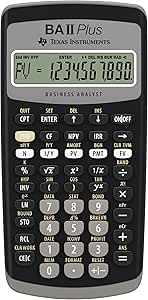 | Best for Property-Investing Beginners | Calculator type: Financial | Model: BA II Plus (IIBAPL/TBL/1L1/C) | Functions: Time value of money, amortization, NPV, IRR, cash-flow analysis, statistics, and financial worksheets | VIEW LATEST PRICE | See Our Full Breakdown |
| Texas Instruments BA II Plus Professional Financial Calculator |  | Best for Uneven Cash-Flow Analysis | Display: 10-digit | Cash-flow capacity: Up to 32 uneven cash flows | Cash-flow frequencies: Up to 4 digits | VIEW LATEST PRICE | See Our Full Breakdown |
| HP 12C Platinum Financial Calculator with 130+ Functions |  | Best for Flexible Entry and Cash-Flow Capacity | Functions: 130+ | Entry modes: RPN and algebraic | Cash-flow storage: Up to 30 cash flows; product description also contains conflicting capacity information | VIEW LATEST PRICE | See Our Full Breakdown |
| investment property calculator | Functions | Model | Power | Warranty |
|---|---|---|---|---|
| Calculated Industries 3400 Poc | — | 3400 | Battery powered; one CR2 battery included | — |
| Calculated Industries 3405 Rea | Mortgage payments, amortization, remaining balances, ARMs, and combination loans | 3405 | — | 1 year |
| Calculated Industries Qualifie | Mortgage and loan calculations, buyer qualification, cash flows, IRR, NPV, rent-versus-buy, commission, and date math | 3430 Qualifier Plus IIIfx | — | 1 year |
| Calculated Industries 3415 Qua | Payment, amortization, ARM, FHA/VA, combination-loan calculations, and buyer pre-qualification | 3415 | — | Full 1-year limited warranty |
| HP 10bII+ Financial Calculator | 100+ | HP 10bII+ | Battery powered; one battery | — |
| HP 12C Financial Calculator wi | 120+ | — | One nonstandard battery; pre-installed | 2 years |
| HP 17bII+ Financial Calculator | 250+ | — | Two pre-installed CR2032 batteries | 2 years |
| Texas Instruments BA II Plus F | Time value of money, amortization, NPV, IRR, cash-flow analysis, statistics, and financial worksheets | BA II Plus (IIBAPL/TBL/1L1/C) | One CR123A battery, included | — |
| Texas Instruments BA II Plus P | — | — | — | 1-year limited manufacturer warranty |
| HP 12C Platinum Financial Calc | 130+ | — | Pre-installed batteries | — |
More Details on Our Top Picks
Calculated Industries 3400 Pocket Real Estate Master Financial Calculator
The 3400 Pocket Real Estate Master is the most straightforward pick here for investors who want core property-finance calculations in a portable format. Dedicated keys handle loan payments, amortization, remaining balances, interest, and future values, making routine mortgage scenarios easier to work through than on the general-purpose HP 10bII+. Its included hard case and four-ounce weight suit property tours or quick conversations away from a desk. The tradeoff is narrower scope: unlike the Qualifier Plus IIIfx, it does not list cash-flow, IRR, or NPV functions, so it is less useful for comparing investment returns. The listed 2.5-inch screen size also comes without further display detail, and the calculator uses a CR2 battery. I’d choose it for portable loan analysis, not full deal underwriting.
Pros:- Dedicated keys cover common loan-payment and amortization calculations.
- Calculates remaining balances, total interest, future values, and dates.
- Weighs four ounces and includes a protective hard case.
- Battery and user guide are included.
Cons:- Does not list cash-flow, IRR, or NPV functions offered by the Qualifier Plus IIIfx.
- Uses a CR2 battery rather than the button-cell setup listed for some alternatives.
- Display information is limited to a listed 2.5-inch screen size.
Best for: Investors and real estate trainees who want a lightweight calculator for mortgage payments, amortization, and balance checks during property visits.
Not ideal for: Buyers comparing rental deals through cash flow, IRR, or NPV, since those investment-analysis functions are not listed.
- Brand:Calculated Industries
- Model:3400
- Calculator type:Financial
- Display:LCD; listed screen size 2.5 inches
- Power:Battery powered; one CR2 battery included
- Weight:4 ounces
- Dimensions:5 inches L x W
- Included items:Protective hard case, user guide, and battery
Our verdict“Choose the 3400 for portable mortgage and amortization work, but pick the Qualifier Plus IIIfx for deeper investment-return analysis.”
Calculated Industries 3405 Real Estate Master IIIx Finance Calculator
For buyers working through residential financing structures, the 3405 Real Estate Master IIIx goes beyond the 3400’s core loan and amortization focus. Its labeled keys cover adjustable-rate mortgages and combination loans as well as payments and remaining balances, helping users compare financing setups without translating every step into generic financial-calculator terms. The protective slide cover and included reference guides make it a practical choice for agents or investors who want support at hand. Compared with the Qualifier Plus IIIfx, though, this model is more centered on loan mechanics; the IIIfx specifically lists cash flows, IRR, and NPV for investment evaluation. The 3405’s specialization is its strength and its limit: it suits mortgage comparisons, but it is not the broadest tool for analyzing rental-property returns.
Pros:- Clearly labeled real estate finance keys reduce reliance on generic calculator terminology.
- Handles payments, amortization, remaining balances, ARMs, and combination loans.
- Includes a protective slide cover and two reference guides.
- Supplied with two batteries and a one-year warranty.
Cons:- Its functions are specialized for residential real estate finance.
- Unlike the Qualifier Plus IIIfx, it does not list cash-flow, IRR, or NPV calculations.
- The supplied specifications do not give display size or dimensions.
Best for: Residential investors, agents, and loan trainees who regularly compare ARMs, combination loans, and standard mortgage scenarios.
Not ideal for: Rental-property analysts who need listed cash-flow, IRR, and NPV tools or a broader investment-return workflow.
- Brand:Calculated Industries
- Model:3405
- Weight:91 g
- Functions:Mortgage payments, amortization, remaining balances, ARMs, and combination loans
- Battery compartment:Tool-secured button-cell compartment
- Included accessories:Protective slide cover, quick reference guide, pocket user’s guide, and two batteries
- Warranty:1 year
Our verdict“Pick the 3405 when residential loan structures are your main calculation need; choose the Qualifier Plus IIIfx for investment-return measures.”
Calculated Industries Qualifier Plus IIIfx Real Estate Calculator
The Qualifier Plus IIIfx earns the strongest fit for buyers who need more than mortgage math from an investment property calculator. Alongside loan and buyer-qualification work, it lists cash flows, IRR, and NPV—useful measures for comparing projected investment outcomes rather than only estimating borrowing costs. That makes it a broader deal-analysis choice than the 3400 Pocket Real Estate Master and the residential-finance-focused 3405. It also includes rent-versus-buy, loan comparisons, commission, and date math, supported by a slide cover and reference guides. The compromise is specialization: its feature set targets real estate and finance rather than general everyday calculations, and the supplied product details omit dimensions and display information. I’d rank it first for investors seeking one handheld tool for financing and return comparisons, while noting that its specs leave some usability details unknown.
Pros:- Combines mortgage and buyer-qualification functions with investment measures.
- Lists cash flows, IRR, and NPV for comparing projected deal outcomes.
- Adds rent-versus-buy, loan-comparison, commission, and date calculations.
- Includes a protective slide cover, reference guides, battery, and one-year warranty.
Cons:- Specialized for real estate and finance rather than general-purpose use.
- The supplied information does not specify dimensions or display details.
- More function breadth may be unnecessary for buyers who only need mortgage-payment calculations.
Best for: Property investors and real estate professionals who want to compare financing alongside projected cash flows, IRR, and NPV.
Not ideal for: People seeking a general-purpose calculator or buyers who require documented screen and size details before choosing.
- Brand:Calculated Industries
- Model:3430 Qualifier Plus IIIfx
- Functions:Mortgage and loan calculations, buyer qualification, cash flows, IRR, NPV, rent-versus-buy, commission, and date math
- Battery safety:Button-cell compartment secured with a tool-required fastener
- Included items:Protective slide cover, quick reference guide, pocket user’s guide, and battery
- Warranty:1 year
Our verdict“Choose the Qualifier Plus IIIfx if your property analysis needs both financing calculations and cash-flow, IRR, or NPV tools.”
Calculated Industries 3415 Qualifier Plus IIIx Real Estate Finance Calculator
The 3415 Qualifier Plus IIIx is aimed at the financing conversation that happens before a buyer settles on a property: its dedicated pre-qualification keys sit alongside mortgage payment, amortization, ARM, FHA/VA, and combination-loan calculations. That gives it a clearer role than the 3400, which focuses on core loan calculations, and a more mortgage-centered remit than the Qualifier Plus IIIfx, whose listed features extend into cash flows, IRR, and NPV. For investment-property buyers, the 3415 can help model borrowing options and buyer capacity, but the supplied data does not list those broader return-analysis functions. It comes with a slide cover and reference guides, though its specialization means it is less appealing as a general calculator. I’d choose it when financing and qualification are the main questions, not when deal returns are the priority.
Pros:- Dedicated keys support buyer pre-qualification.
- Covers payment, amortization, ARM, FHA/VA, and combination-loan calculations.
- Includes a protective slide cover and reference guides.
- Has a secured button-cell compartment and a one-year limited warranty.
Cons:- Designed primarily for real estate and mortgage finance.
- The supplied function list does not include cash flow, IRR, or NPV.
- Product details do not specify dimensions or display characteristics.
Best for: Real estate professionals and investors who need to estimate buyer qualification and compare mortgage, ARM, FHA/VA, or combination-loan scenarios.
Not ideal for: Investors whose main task is comparing rental cash flow, IRR, or NPV, since those functions are not listed.
- Brand:Calculated Industries
- Model:3415
- Item type:Real estate finance calculator
- Weight:91 g
- Functions:Payment, amortization, ARM, FHA/VA, combination-loan calculations, and buyer pre-qualification
- Battery safety:Secured button-cell compartment with tool-required fastener
- Included items:Protective slide cover, quick reference guide, pocket user’s guide, and long-life batteries
- Warranty:Full 1-year limited warranty
Our verdict“Choose the 3415 for mortgage scenarios and buyer qualification, but favor the Qualifier Plus IIIfx for listed investment-return calculations.”
HP 10bII+ Financial Calculator with 100+ Functions
The HP 10bII+ suits buyers who want investment calculations in a broader financial tool rather than a real-estate-specific keypad. Its listed functions include time value of money, loan payments, cash flows, NPV, and IRR, putting it closer to the Qualifier Plus IIIfx for return analysis than the mortgage-centered 3405. More than 100 functions, probability distributions, and algebraic or chain logic also make it useful for finance, accounting, and statistics work beyond property deals. That flexibility comes with a learning and workflow tradeoff: the dedicated real-estate keys on the Calculated Industries models may be quicker for routine mortgage questions. The LCD is non-backlit, so it lacks an illuminated display, and the plastic enclosure differs from the metal-bodied 3400. I’d choose the HP for cross-discipline use, not for the most property-specific interface.
Pros:- Lists time-value-of-money, loan-payment, cash-flow, NPV, and IRR functions.
- Offers more than 100 functions, including probability distributions.
- Algebraic and chain logic give users two calculation-entry approaches.
- Includes a protective case, cleaning cloth, batteries, and a two-year warranty.
Cons:- The LCD is non-backlit.
- Its general financial layout is less real-estate-specific than the Calculated Industries models.
- Plastic enclosure may feel less durable than the metal enclosure listed for the 3400.
Best for: Investors, finance students, and analysts who need property cash-flow and return calculations alongside broader finance or statistics functions.
Not ideal for: Buyers who prioritize labeled real-estate keys for quick mortgage workflows or require a backlit display.
- Brand:HP
- Model:HP 10bII+
- Functions:100+
- Logic:Algebraic and chain
- Display:4-inch non-backlit LCD
- Power:Battery powered; one battery
- Enclosure and dimensions:Plastic; 6 x 3 inches
- Included accessories and warranty:Protective case, cleaning cloth, batteries, and 2-year warranty
Our verdict“Choose the HP 10bII+ if you want property-return calculations in a versatile finance calculator, rather than a dedicated real estate keypad.”
HP 12C Financial Calculator with 120+ Functions, RPN, Case, and Cleaning Cloth
The HP 12C suits investors who want a compact financial tool for mortgage amortization, depreciation, and investment cash-flow work without a real-estate-specific interface. Its RPN entry can make repeated calculations efficient once the keystroke sequence feels familiar, and programmable sequences help reduce repetitive input. Compared with the HP 12C Platinum, this version stores fewer cash flows and lacks algebraic entry, so it is less flexible for investors switching from standard calculator notation or modeling uneven scenarios. The stated capacity of up to 20 cash flows can still serve smaller analyses, but investors comparing multiple properties or complex timelines may prefer the Platinum or the BA II Plus Professional. The included case and pre-installed battery are practical extras; the nonstandard battery is a longer-term inconvenience.
Pros:- More than 120 financial functions cover amortization, depreciation, NPV, and IRR
- RPN entry and programmable keystrokes can speed up recurring calculation sequences
- Protective case, cleaning cloth, and pre-installed battery are included
Cons:- RPN may be unfamiliar to users accustomed to algebraic entry
- The nonstandard battery may be less convenient to replace
- Capacity of up to 20 cash flows is lower than the stated capacity of the HP 12C Platinum
Best for: Investors comfortable with RPN who want a compact calculator for recurring loan, amortization, and modest cash-flow calculations.
Not ideal for: Buyers who prefer algebraic entry or need to model many uneven cash flows; the HP 12C Platinum offers both entry modes and higher stated cash-flow capacity.
- Calculator type:Financial
- Functions:120+
- Entry method:Reverse Polish Notation (RPN)
- Programmable:Yes
- IRR/NPV cash-flow capacity:Up to 20 cash flows
- Display:LCD
- Power:One nonstandard battery; pre-installed
- Dimensions:6 in L × 3 in W
- Warranty:2 years
Our verdict“Choose this HP 12C if you value RPN-based financial work and do not need algebraic entry or a large cash-flow model.”
HP 17bII+ Financial Calculator with RPN and Algebraic Entry
The HP 17bII+ is the most adaptable HP option here for investors who move between familiar algebraic entry and RPN. Its 250+ functions span finance, business, and real estate, while custom equation solving and stored equations can help repeat a property-analysis method without rebuilding it each time. That breadth gives it an advantage over the simpler HP 12C, which is centered on RPN and has fewer functions. A two-line display makes entries easier to inspect than a single-line view, though it still shows limited information at once; the BA II Plus Professional is a more direct fit for buyers focused on extensive uneven cash-flow analysis. The 17bII+ is a general financial calculator rather than a property-specific tool, so it will not replace dedicated real-estate workflows. Its 28 KB of memory and two CR2032 batteries are useful details, but the display and battery type are tradeoffs.
Pros:- Supports both RPN and algebraic entry, accommodating different calculation habits
- More than 250 functions cover finance, accounting, business, and real estate
- Custom equation solving and 28 KB of memory support reusable calculations
- Includes a protective case, cleaning cloth, and two pre-installed batteries
Cons:- The two-line display limits how much information is visible at once
- Uses CR2032 batteries, which may be less convenient to source than common calculator cells
- Broad functionality can be more than an investor needs for straightforward property screening
Best for: Property investors and finance professionals who want both RPN and algebraic entry, reusable equations, and a broad set of business and real-estate functions.
Not ideal for: Buyers who want a calculator centered on large uneven cash-flow analysis or need extensive results visible at once; the BA II Plus Professional is more specialized for cash-flow modeling.
- Calculator type:Financial
- Functions:250+
- Entry modes:RPN and algebraic
- Display:Two-line, 22-character LCD
- Memory:28 KB
- Power:Two pre-installed CR2032 batteries
- Dimensions:6 in L × 3 in W
- Included accessories:Protective case and cleaning cloth
- Warranty:2 years
Our verdict“Pick the HP 17bII+ if you want entry-method flexibility and reusable equations more than a specialized, high-capacity cash-flow workflow.”
Texas Instruments BA II Plus Financial Calculator
The TI BA II Plus is a practical starting point for investors learning to calculate mortgage payments, time value of money, NPV, and IRR. Its worksheet mode keeps tasks such as amortization, bonds, and depreciation organized, while stored worksheet values reduce the need to re-enter figures when revisiting an analysis. Compared with the BA II Plus Professional, the standard model is the simpler choice, but it does not offer the Professional version’s stated capacity for up to 32 uneven cash flows or its additional functions such as MIRR and modified duration. That difference matters when rental income, renovation spending, and resale proceeds arrive on irregular schedules. The BA II Plus can support property screening, but its worksheets take learning and some calculations may call for the manual. It is also not a dedicated real-estate calculator like the Calculated Industries models in this roundup.
Pros:- Worksheets cover time value of money, amortization, bonds, depreciation, and compound interest
- Built-in memory retains previous worksheet values for follow-up calculations
- Supports cash-flow analysis, NPV, and IRR for basic investment evaluation
- Slide case and included CR123A battery are supplied
Cons:- Financial worksheets can take time to learn, and the manual may be needed for some calculations
- Less capable than the BA II Plus Professional for stated uneven cash-flow capacity and specialized functions
- Does not provide the property-specific workflow of the Calculated Industries real-estate calculators
Best for: New property investors and finance students learning loan, amortization, and basic investment-return calculations through worksheets.
Not ideal for: Investors who regularly model many uneven cash flows or want a real-estate-specific interface; consider the BA II Plus Professional or a dedicated Calculated Industries model.
- Calculator type:Financial
- Model:BA II Plus (IIBAPL/TBL/1L1/C)
- Functions:Time value of money, amortization, NPV, IRR, cash-flow analysis, statistics, and financial worksheets
- Memory:Retains previous worksheet values
- Power:One CR123A battery, included
- Weight:3.68 oz
- Dimensions:6.48 × 2.98 × 0.72 in
- Material:ABS plastic
- Included accessory:Slide case
Our verdict“Choose the BA II Plus if you are learning core property-finance calculations and do not yet need the Professional model’s expanded cash-flow tools.”
Texas Instruments BA II Plus Professional Financial Calculator
For investors building a more detailed property timeline, the BA II Plus Professional stands out for handling up to 32 uneven cash flows and calculating NPV, IRR, MIRR, NFV, payback, and discounted payback. That capacity can help represent irregular renovation costs, leasing gaps, and sale proceeds more faithfully than the standard BA II Plus, whose description does not specify the same uneven-cash-flow capacity. Depreciation, modified duration, and regression tools extend its usefulness beyond a simple rental-property screen. The tradeoff is focus: this is a finance-oriented calculator, not a property-specific device like the Calculated Industries Qualifier Plus IIIfx. Buyers should also note its one-year limited warranty, shorter than the two-year warranties listed for the HP 12C and HP 17bII+. Choose it for analytical range rather than a guided real-estate workflow or broad general-purpose computing.
Pros:- Analyzes up to 32 uneven cash flows
- Includes NPV, IRR, MIRR, NFV, payback, and discounted-payback functions
- Supports depreciation schedules and one- and two-variable regression
- Automatic power down and rugged metal exterior are specified
Cons:- Specialized for finance and business calculations rather than general-purpose or real-estate-specific use
- Its broader feature set may add complexity for basic rental-property screening
- One-year limited manufacturer warranty is shorter than the two-year HP calculator warranties listed here
Best for: Experienced property investors and finance users who need to model irregular cash flows, compare return measures, or calculate depreciation.
Not ideal for: First-time investors who want a guided property-specific workflow or only need basic mortgage and return calculations; the standard BA II Plus is a simpler alternative.
- Display:10-digit
- Cash-flow capacity:Up to 32 uneven cash flows
- Cash-flow frequencies:Up to 4 digits
- Financial functions:TVM, amortization, depreciation, IRR, MIRR, NPV, NFV, modified duration, payback, and discounted payback
- Statistics:One- and two-variable statistics with linear, logarithmic, exponential, and power regression
- Power management:Automatic Power Down
- Exterior:Rugged metal
- Warranty:1-year limited manufacturer warranty
Our verdict“Select the BA II Plus Professional when irregular cash flows and advanced return measures matter more than a beginner-friendly property workflow.”
HP 12C Platinum Financial Calculator with 130+ Functions
The HP 12C Platinum keeps the familiar financial focus of the HP 12C while adding algebraic entry alongside RPN, making it a more accommodating choice for investors who do not want to commit to one input style. Its stated capacity of up to 30 cash flows also exceeds the standard HP 12C’s 20, which can help when a property model includes more income or expense events. Undo and Backspace keys provide a way to correct input mistakes without restarting a calculation. Compared with the BA II Plus Professional, though, its listed cash-flow capacity is slightly lower, and the supplied product description contains conflicting cash-flow specifications—so buyers should verify the exact capacity before relying on it for a detailed model. It remains a financial calculator, not a dedicated real-estate underwriting tool.
Pros:- Supports both RPN and algebraic entry
- More than 130 functions cover loans, interest rates, amortization, depreciation, IRR, and NPV
- Undo and Backspace keys help correct input errors
- Includes a protective case, cleaning cloth, and pre-installed batteries
Cons:- Product information contains conflicting cash-flow specifications, so the listed capacity should be verified
- The stated capacity of up to 30 cash flows is below the BA II Plus Professional’s 32
- Designed for financial and business calculations rather than a dedicated real-estate workflow
Best for: Investors who want both algebraic and RPN entry, correction keys, and more cash-flow capacity than the standard HP 12C.
Not ideal for: Buyers who need clearly documented, higher-capacity uneven cash-flow analysis or a property-specific calculator; the BA II Plus Professional or Calculated Industries models may fit better.
- Functions:130+
- Entry modes:RPN and algebraic
- Cash-flow storage:Up to 30 cash flows; product description also contains conflicting capacity information
- Input correction:Undo and Backspace keys
- Financial functions:Loan payments, interest rates, amortization, depreciation, IRR, and NPV
- Exam approvals:CFP, CFA, and GARP FRM exams
- Included accessories:Protective case and cleaning cloth
- Power:Pre-installed batteries
Our verdict“Choose the HP 12C Platinum if you want the HP financial-calculator approach with two entry modes, but verify its cash-flow capacity before modeling complex deals.”

How We Picked
I ranked these calculators by how directly they support common investment-property calculations, including loan and payment analysis, property-specific workflows, and repeatable scenario checks. I also weighed input style, breadth of financial functions, portability, and how much general finance capability a buyer gets alongside real estate tools. Because calculators do not replace property research or a full underwriting model, I favored tools that can make routine calculations clearer without implying that a single output validates a deal.
The Calculated Industries models rank highest for buyers who want real-estate-oriented functions close at hand. General financial calculators from HP and Texas Instruments remain useful for mortgage and time-value calculations, but their relative fit depends on the user’s familiarity with the interface and need for broader finance work. I treated a larger function count as a benefit only when it matched a plausible buyer need; a more specialized or easier-to-operate model can be the better choice for frequent property screening.
| investment property calculator | Brand | Power |
|---|---|---|
| Calculated Industries 3400 Poc | Calculated Industries | Battery powered; one CR2 battery included |
| Calculated Industries 3405 Rea | Calculated Industries | — |
| Calculated Industries Qualifie | Calculated Industries | — |
| Calculated Industries 3415 Qua | Calculated Industries | — |
| HP 10bII+ Financial Calculator | HP | Battery powered; one battery |
| HP 12C Financial Calculator wi | — | One nonstandard battery; pre-installed |
| HP 17bII+ Financial Calculator | — | Two pre-installed CR2032 batteries |
| Texas Instruments BA II Plus F | — | One CR123A battery, included |
| Texas Instruments BA II Plus P | — | — |
| HP 12C Platinum Financial Calc | — | Pre-installed batteries |
Factors to Consider When Choosing Investment Property Calculators
Choosing among investment property calculators is less about collecting the most functions and more about matching the tool to your analysis routine. These broader factors can help you avoid paying for complexity you will not use or buying a model that makes common calculations awkward.
Match the calculator to your deal workflow
Start by listing the calculations you repeat, rather than shopping by function count. A buyer who quickly screens rents, financing, and recurring costs may benefit from property-specific shortcuts, while an investor comparing financing structures may need broader financial functions. A common mistake is to assume that any financial calculator handles every real estate metric directly. Some measures, such as cash-on-cash return or cap rate, may still require you to organize inputs and perform additional arithmetic. Before choosing, write down one typical deal and check whether the calculator supports the steps you actually use. The best fit reduces friction in that workflow without encouraging you to treat a calculator output as a complete investment decision.
Separate loan math from investment judgment
A calculator can help quantify payments, interest, and financing scenarios, but it cannot determine whether your rent, vacancy, repairs, or resale assumptions are realistic. Buyers often focus on mortgage payments and overlook expenses that vary by property, such as maintenance, insurance, taxes, and periods without a tenant. Decide which figures you will calculate on the device and which you will track in a spreadsheet or property analysis tool. This division helps prevent a neat payment result from being mistaken for reliable cash flow. If you underwrite many properties, a calculator is most useful as a fast check alongside a consistent written model. For a one-off purchase, simpler tools may be enough if you already have a sound way to account for operating costs.
Choose an input style you can use accurately
RPN and algebraic entry are different ways to enter calculations, and familiarity can affect both speed and error risk. A buyer comfortable with RPN may appreciate its workflow, while someone accustomed to conventional equations may find algebraic entry easier to pick up. Do not choose an input method just because an advanced model offers it; repeated hesitation while entering figures can undermine the convenience of a handheld calculator. Try a few representative calculations using the manual or product documentation before committing. Also check how the model handles stored values and repeated operations if you compare many scenarios. For property analysis, consistent inputs matter more than a theoretically faster method that you are likely to misuse.
Pay for breadth only when you will use it
Broad function sets can make a calculator useful beyond property purchases, including general finance, business, or coursework. That added range has less value if you mainly need a small set of recurring real estate calculations. A common buying error is treating a higher function count as proof that a model is better for investment analysis. Instead, identify which extra capabilities would support your actual work and whether the interface makes them accessible. Buyers who handle diverse financing problems may welcome a more capable model; occasional investors may prefer a focused device with fewer steps for familiar tasks. The right choice is the one whose functions you can name and expect to use.
Consider portability and your backup process
A handheld calculator is convenient for property visits, conversations, and quick comparisons, but it should not become the only record of your assumptions. Keep deal inputs, calculation notes, and key outputs in a durable system so you can revisit or share your reasoning later. Compact models can be easier to carry, while a larger or more feature-rich device may suit a desk-based workflow. Check the product details for power requirements, case or protective accessories, and the physical layout that will work for your setting. If you regularly analyze deals away from a desk, portability and legibility may matter more than features you rarely access. For detailed underwriting, use the calculator for quick checks and preserve the complete analysis elsewhere.
Frequently Asked Questions
Can a financial calculator calculate rental property cash flow?
It can help with parts of the calculation, especially loan payments and other financial inputs, but cash flow depends on more than financing. You also need to account for rent actually collected, vacancy, operating expenses, and any reserves or capital costs you include in your method. Some values may require separate arithmetic or a spreadsheet, depending on the model. Use the same definitions for expenses and income each time you compare properties so the results remain consistent. A calculator output is a useful check, not a substitute for a complete property budget.
Should I choose a real-estate-specific calculator or a general financial calculator?
Choose a real-estate-specific model if you want property-oriented shortcuts to support repeated deal screening. A general financial calculator may fit better if you already know its workflow or also need broader finance calculations outside real estate. The deciding question is whether your routine work is made faster by dedicated property functions or by a wider set of general tools. Check the calculations you perform most often against the model’s documented functions before buying. Neither type removes the need to track local costs and property-specific assumptions separately.
Is RPN a good choice for real estate investing calculations?
RPN can be efficient for people who already understand the entry sequence, and the HP 12C models in this roundup offer that style. It is not automatically faster for everyone: buyers used to standard equation entry may make fewer mistakes with an algebraic interface. Since deal analysis often involves changing figures repeatedly, comfort with the input method matters more than a feature list suggests. Practice entering a loan or payment calculation before making your choice. If you share the calculator with someone else, consider whether they can use the same entry style confidently.
Can I rely on a handheld calculator instead of a spreadsheet for underwriting?
A handheld calculator works well for quick checks and focused calculations, but a spreadsheet is usually better for preserving assumptions and comparing multiple properties or scenarios. Property underwriting can involve many changing inputs, including rent, vacancy, repairs, taxes, and financing terms. A calculator may help verify a payment or test a value, while a separate record keeps the full deal logic visible. If you use only a calculator, write down each assumption and result so you can audit the analysis later. For larger decisions, treat both tools as aids to judgment rather than proof that a property is a sound investment.
Which features matter most if I am buying my first investment property?
Prioritize an interface you can use consistently, clear support for the loan calculations you expect to run, and a way to record your assumptions outside the device. A large function count can be distracting if you are still learning how financing, operating costs, and returns fit together. Beginners should first define a repeatable deal checklist and confirm that the calculator handles the calculations in that checklist. It is also useful to compare the result with a spreadsheet or another independent calculation while learning. That process can catch input errors and clarify which costs are missing from an initial estimate.
Conclusion
For most property-focused buyers, I recommend the Calculated Industries 3405 Real Estate Master IIIx as the best overall because it balances real estate orientation with broader financial calculations. The 3400 Pocket Real Estate Master is my best value-style pick for buyers who want a compact specialist rather than a wide-ranging finance tool. For beginners, choose the calculator whose input method feels familiar and whose main calculations match a written deal checklist; do not buy complexity as a substitute for learning underwriting. The HP 12C Platinum is the best premium-style choice for buyers who want a broader function set and both RPN and algebraic entry options. For specific needs, consider the other Calculated Industries models when property-focused shortcuts are your priority, or the HP and Texas Instruments calculators when general financial work and familiar finance workflows matter more. Whatever you choose, keep full deal assumptions and operating-cost analysis in a separate, reviewable record.
Halloween Picks

Gemmy 6.4 ft Beetlejuice Animatronic Halloween Decoration with Spinning Head

8.5 Foot Halloween Inflatable Haunted House Castle with Skeleton, Ghost & Skulls

Pumpkin Halloween Fog Machine with 12-Color LED Lights, Bluetooth Speaker, and Remote
As an affiliate, we earn on qualifying purchases.