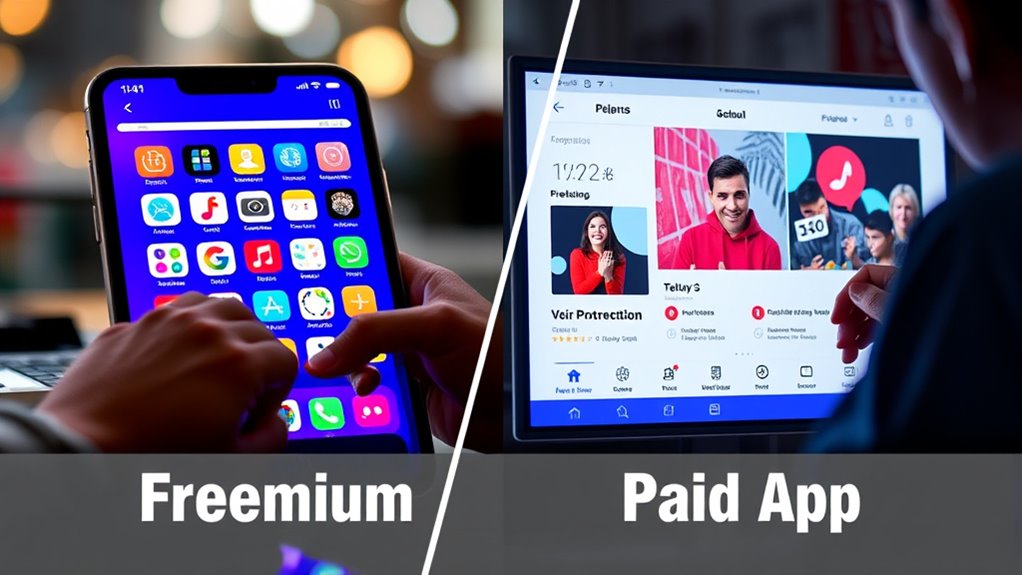

Choosing between freemium and paid models depends on your growth goals and target market. Freemium attracts a broad user base quickly, helps build trust, and encourages upgrades over time, but requires careful feature gating to keep users engaged. Paid models offer predictable revenue and focus on high-value features for niche audiences. To decide the best fit, consider your product type and user behavior—exploring these elements will give you a clear strategy.

Get smart everyday buys delivered free with Prime
- Fast, free delivery on millions of items
- Prime Video, Amazon Music and more included
- Member-only deals all year
Key Takeaways
- Freemium attracts a large user base quickly, ideal for widespread awareness and long-term engagement.
- Paid models offer predictable revenue and higher initial income, suitable for niche markets emphasizing quality.
- Freemium requires strategic feature gating to balance user satisfaction and encourage upgrades.
- Paid models depend on delivering compelling value to justify upfront costs and retain customers.
- Combining free trials with paid plans can optimize user engagement and maximize revenue potential.

When choosing between freemium and paid models, understanding how each approach impacts your business and user experience is essential. The decision can profoundly influence user engagement and your revenue streams. Freemium models offer users a free version with optional upgrades, which can attract a large user base quickly. This broad reach often boosts user engagement because more people try your product without committing financially upfront. As users become familiar with your service, they’re more likely to convert to paying customers for premium features they find valuable. However, while freemium can generate high engagement, it also demands a careful balance; if too many features are locked behind paywalls, users might feel frustrated or disengaged, possibly leading to high churn rates.
Choosing between freemium and paid models impacts user engagement and revenue—balance features to keep users satisfied and loyal.
On the other hand, paid models require users to make an upfront investment before experiencing your product. This approach tends to attract more committed customers who value your offering enough to pay for it from the start. Because these users are directly paying, your revenue streams are more predictable, and you can focus on delivering a premium experience without constantly worrying about unlocking features or managing free users. Paid models often result in higher initial revenue per customer, but they can limit user engagement initially, as some potential users may hesitate to pay without trying the product first. This means you’ll need a compelling value proposition to convert visitors into paying customers and keep them engaged over time.
The choice between freemium and paid models also hinges on your market and product type. If your goal is rapid user growth and widespread awareness, freemium can be more effective, leveraging the free version to build user engagement and trust. Over time, you can monetize a portion of these users through upgrades, subscriptions, or in-app purchases. Conversely, if your product targets a niche market with high-value features, a paid model might be better suited, emphasizing quality and exclusivity. This approach can help establish a strong revenue stream from the outset, but you’ll need to guarantee your marketing efforts emphasize the value that justifies the upfront cost.
Additionally, understanding the user behavior associated with different models can help you tailor your strategy more effectively. Ultimately, understanding how each model influences user engagement and revenue streams allows you to tailor your strategy to your business goals. Combining elements of both, such as a free trial period followed by a paid plan, can also be a powerful way to maximize engagement while securing reliable income. Whichever route you choose, aligning it with your target audience’s preferences and behavior is key to long-term success.
As an affiliate, we earn on qualifying purchases.
Frequently Asked Questions
How Do Freemium and Paid Models Impact User Retention?
Freemium and paid models substantially impact your user retention by offering different incentives. Free users stay engaged longer when they see valuable features, encouraging upgrades to premium. You keep users interested by providing a seamless path to premium upgrades, boosting retention. When free users find enough value, they’re more likely to convert, ensuring they stay loyal. Ultimately, a balanced approach helps you maintain a strong user base and maximize revenue.
Which Model Offers Better Long-Term Revenue Stability?
You’ll find that paid models generally offer better long-term revenue stability, with studies showing they generate 25% higher customer lifetime value than freemium models. By focusing on monetization strategies that emphasize upfront payments, you guarantee consistent income streams. Relying solely on freemium can leave you vulnerable to unpredictable user behavior, so diversifying revenue sources through both models helps secure your business’s financial future and supports sustainable growth.
How Do Customer Support Needs Differ Between Models?
You’ll find customer support needs differ markedly between models. With freemium, you’ll need to focus on maintaining high user engagement and providing scalable support, as free users often seek quick help and can increase support load. In paid models, support tends to be more personalized, reducing support scalability issues. You should adjust your support strategies accordingly, ensuring you meet user expectations and keep engagement high across both models.
What Are the Legal Considerations for Each Strategy?
Imagine walking a tightrope—balancing legal risks. You must protect intellectual property rights and guarantee regulatory compliance for both models. For freemium, clarify licensing terms and data privacy policies, while paid models demand transparent contracts and adherence to consumer laws. Ignoring these legal considerations could cost you dearly, so stay vigilant, document agreements thoroughly, and consult legal experts to maintain a safe, compliant strategy in both approaches.
How Do These Models Influence Brand Perception?
Your chosen model directly influences your branding perception and customer trust. A freemium model can boost trust by offering value upfront, but if users feel nickel-and-dimed, it may harm your brand. Paid models often enhance perception of quality and exclusivity, fostering trust among serious customers. Ultimately, aligning your strategy with your brand values guarantees you build a positive perception, strengthening loyalty and credibility with your audience.
paid subscription management tools
As an affiliate, we earn on qualifying purchases.
As an affiliate, we earn on qualifying purchases.
Conclusion
So, here you are, weighing the free ride against the paid path, thinking one will save you money while the other promises quality. Ironically, the free model often costs you more in time and frustration, while the paid version might just be the shortcut you need. Sometimes, spending a little upfront saves loads later—so, choose wisely. After all, in the world of business, the cheapest option isn’t always the best deal.
As an affiliate, we earn on qualifying purchases.
As an affiliate, we earn on qualifying purchases.
Halloween Picks
halloween
As an affiliate, we earn on qualifying purchases.